
PIERO MANZONI: TOTAL SPACE, FLORENCE VACHER, and THIS MUST BE THE PLACE.
PIERO MANZONI: TOTAL SPACE at Magazzino Italian Art, Cold Spring, N.Y., through March 23, ‘26.
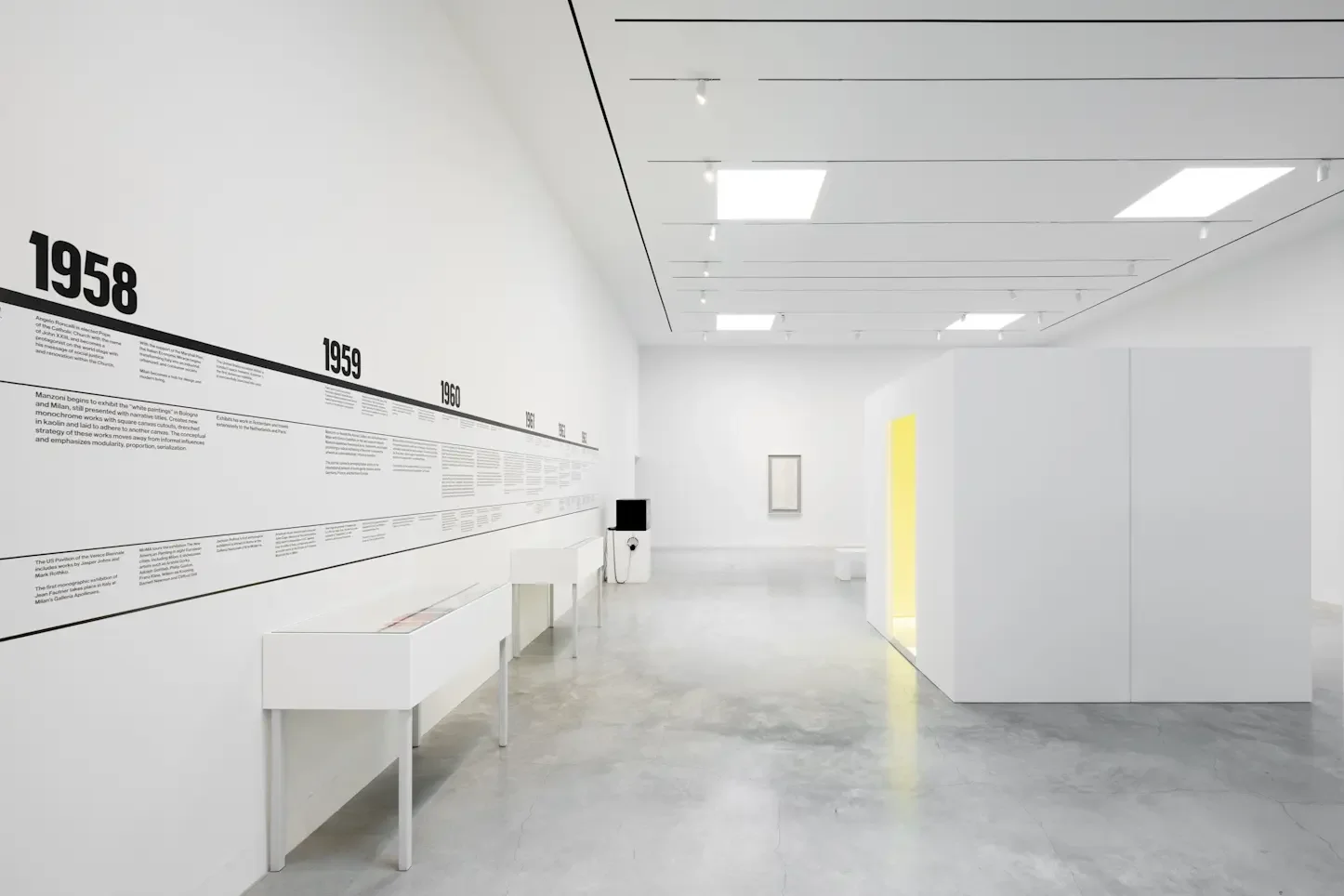
Installation view, Piero Manzoni: Total Space at the Robert Olnick Pavilion at Magazzino Italian Art; Photo Alexa Hoyer.
Piero Manzoni had a brief career, barely a decade long. But since his death in 1963, from a heart attack in his Milan studio, at age 29, his reputation and legacy in Italy and abroad have grown enormously. He pushed the envelope as to what art could do or be. He explored spatial relationships in his white monochrome abstract compositions, the much-lauded Achromes of the late 1950s—a group of fine examples are included in this exhibition. He also delved into conceptual- and body art, such as filling ballons with his breath, and created anti-art gestures, such as his notorious Merda d’artista of 1961. Piero Manzoni: Total Space features the debut of two works of installation art that were proposed by the artist in a letter but never realized during his lifetime. Offering viewers an immersive experience, the works are actual small rooms situated within the largest gallery space of Magazzino’s Robert Olnick Pavilion.
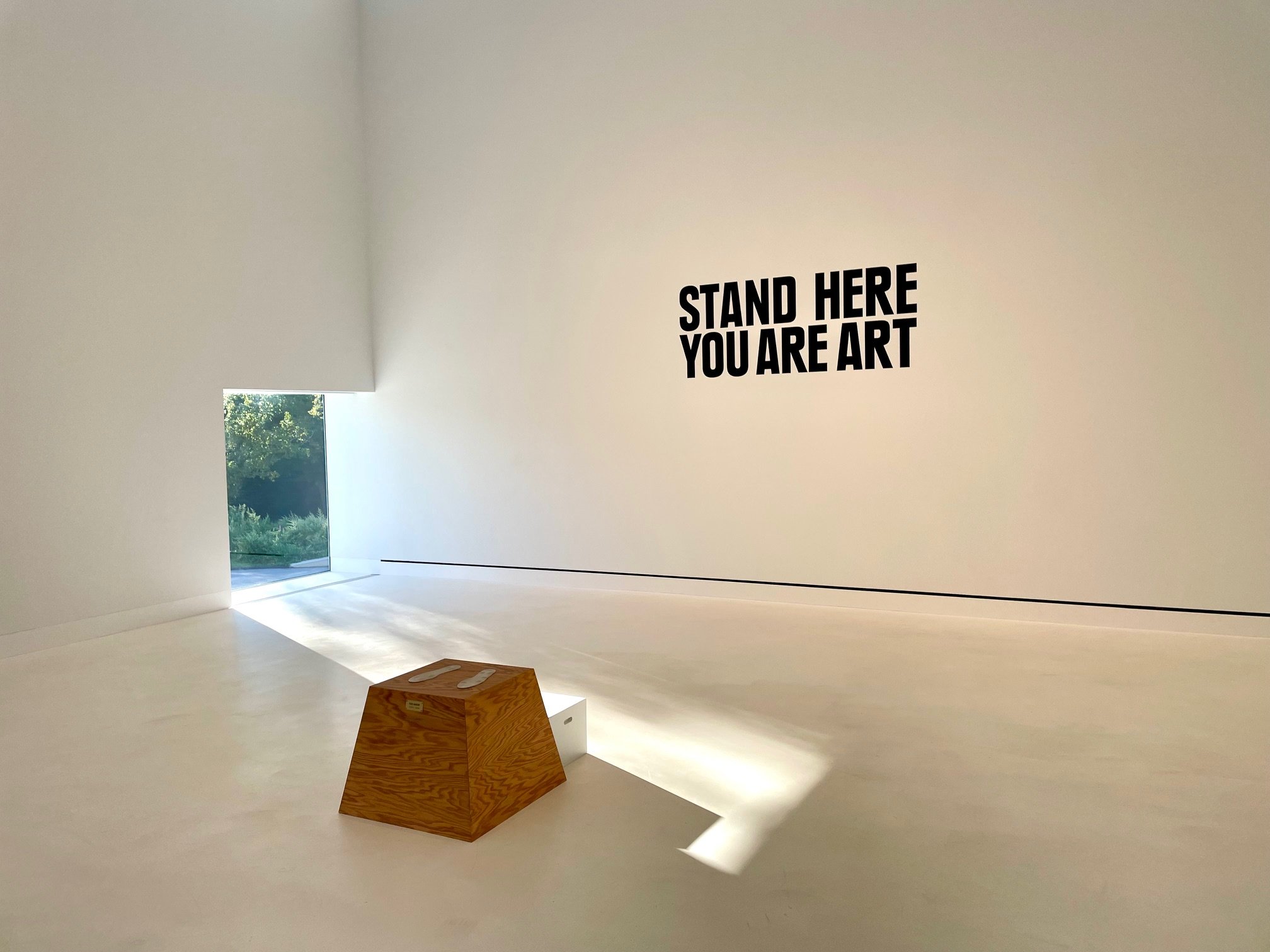
Installation view, Piero Manzoni: Total Space at the Robert Olnick Pavilion at Magazzino Italian Art; Photo David Ebony.
Visitors are welcome to enter each of these rooms, preferably one person at a time. In Stanza fosforescente (Phosphorescent Room), motion sensors trigger a light fixture that emanates a chartreuse glow as viewers step into the room and close the door. It is a gently jarring experience that can subtly alter one’s consciousness for a moment without a lot of bombast. The floors and ceiling of Stanza pelosa (Hairy Room) are covered with a white shag-carpet-like synthetic fur. The stark tactility of this environment could be inviting or repelling, depending on one’s mood. Constructed with the guidance of architect Stephanie Goto, the works were recently donated to Magazzino by the Fondazione Piero Manzoni and Hauser & Wirth. Rounding out this extraordinary exhibition is Base Magica (Magical Base) consisting of a small platform that visitors can mount to become a work of art for a while—in theory, at least. And particularly useful for Manzoni scholars and enthusiasts is a wall-mounted timeline, several rarely seen videos continually playing on a monitor, and vitrines filled with a wealth of documentary material.
FLORENCE VACHER, JMB Fine Art, Hudson, N.Y., through February 15, ‘26.
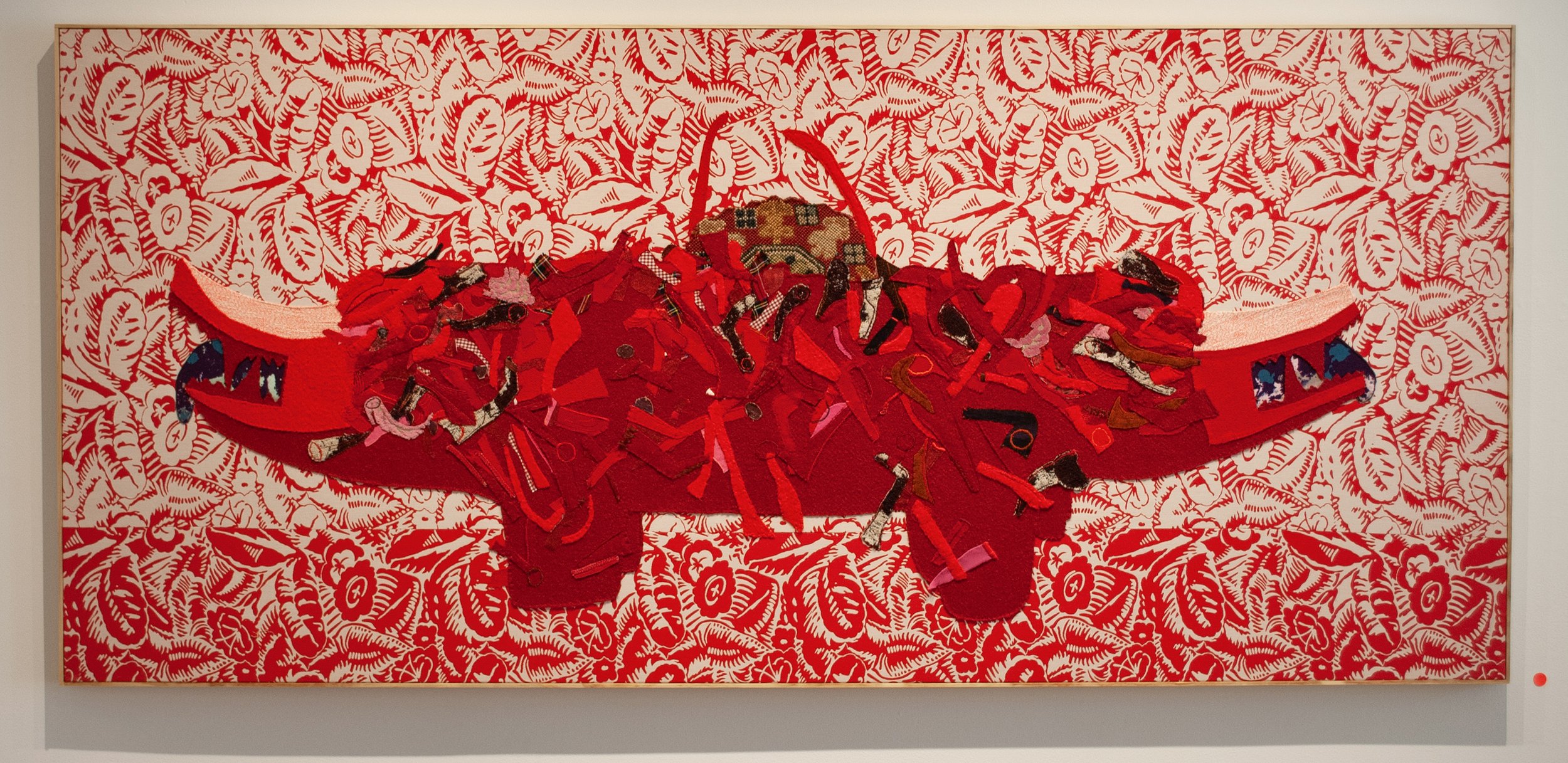
Florence Vacher, Hot Dog (2016); Photo courtesy JMB Fine Art.
French-born Brooklyn-based artist Florence Vacher has been employed as a curator for a private collector, and specializes in ancient art and African art, which are vividly evoked in her striking works made of collaged fabrics and embroidery. Her compositions have an almost palpable historical depth, but that is not to say that she engages in any kind of nostalgia or arcane references in her compositions. Her works are unmistakably contemporary and have a distinctly feminist feel in the materials and imagery. The works on view in this exhibition were for the most part inspired by a 2011 visit to Mexico. The large Hot Dog (2016), for instance, with its variety of bright-red pieces of cloth, suggests a merger of Colonial Period textile designs ( in the floral-pattern background), and Pre-Columbian imagery, such as the elongated form at the center of the composition that recalls a sacrificial altar used in Maya rituals, for instance.
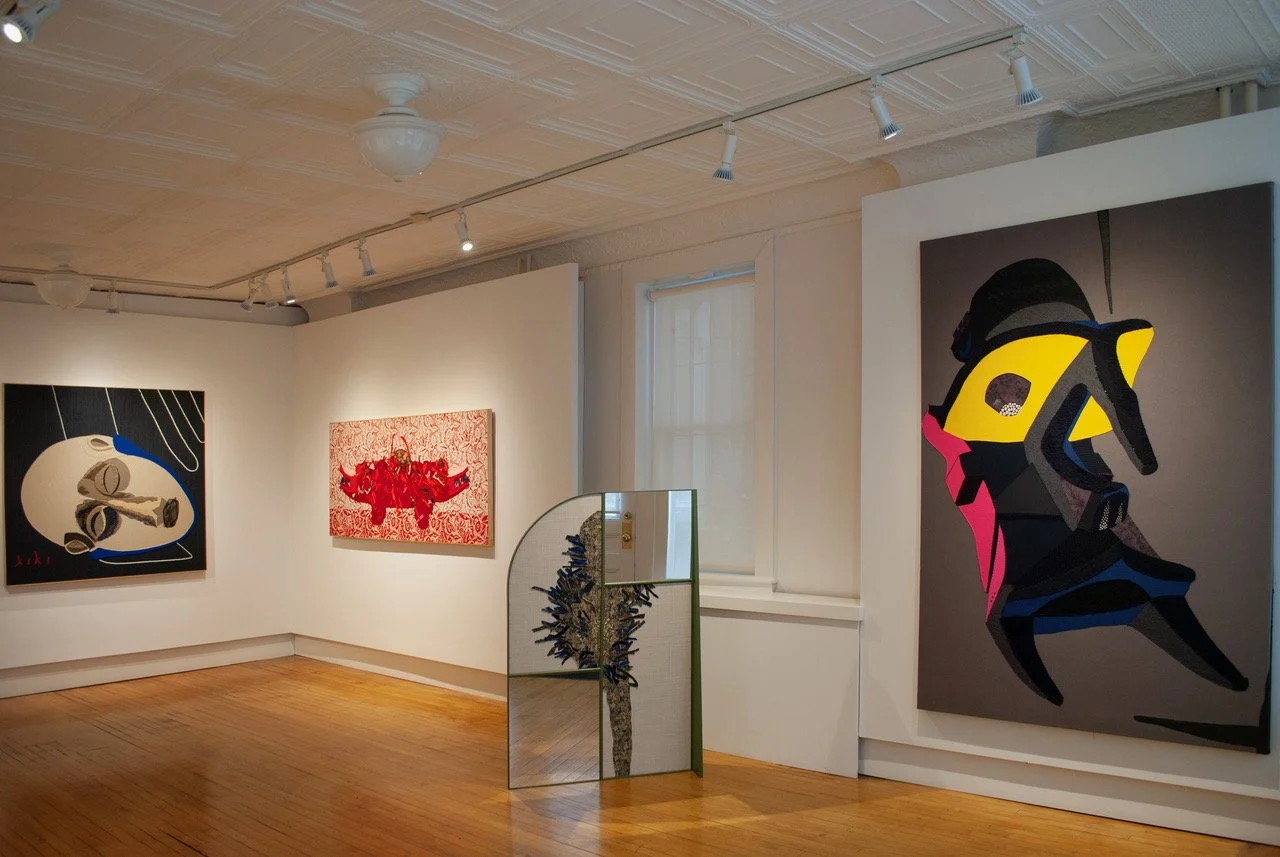
Installation view, Florence Vacher, 2025; Photo courtesy JMB FIne Art.
Vacher is also inspired by early Modernism and especially Cubism and the works of Jacques Lipchitz. Several works, such as Kiki (2022), and Bobby (2025), center on an elongated head with stylized facial features embellished with delicate strands of embroidery. They recall an African mask, albeit seen through the lens of Proto-Cubist Picasso. The Picasso reference is especially evident in Ceci n’est pas une Demoiselle (2024), despite the work’s tongue-in-cheek title. The sole sculptural work on view, Whispering Wall (2025), appears as an elegant screen or room divider. Its curvilinear shape and mirrored segments hint at a work of Art Deco in its graceful and uncluttered comportment. The imposing Floating Elephant (2011) has a monumental feel. Here, against a taupe background, a centralized form composed of facets of colorful hard-edge shapes seems hardly representational. However, large yellow ears and a long black trunk might be discernable with just a bit of imagination. —David Ebony
THIS MUST BE THE PLACE. at Wassaic Project, Wassaic, N.Y., through March 14, ‘26.
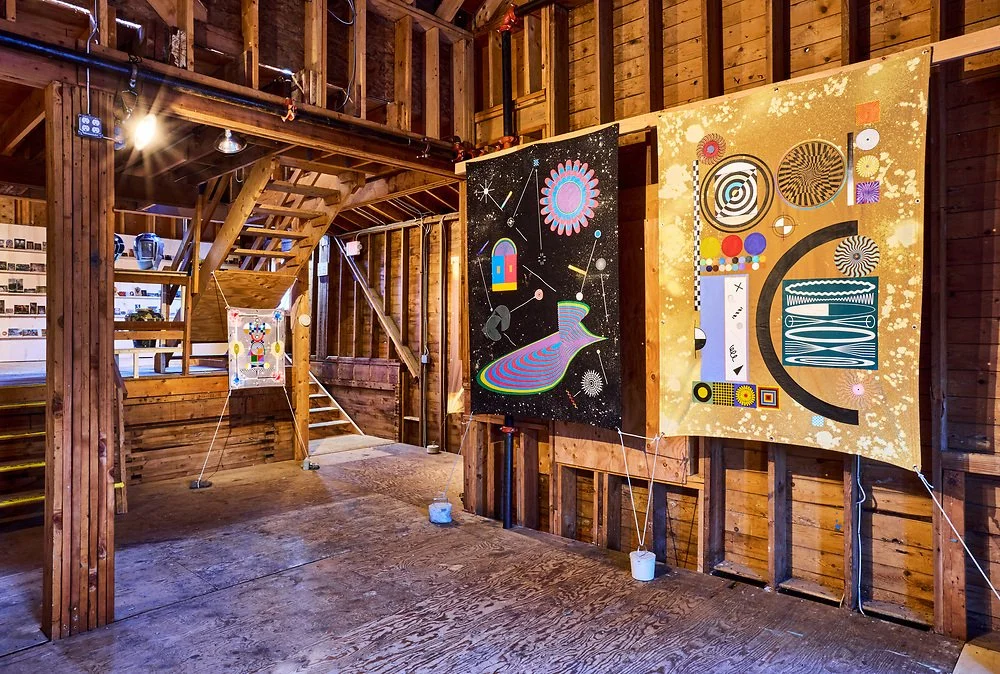
Installation view, This Must Be The Place, 2025, showing in the foreground works by Kim Mullis; Photo Josh Simpson, courtesy Wassaic Project
A sprawling group show featuring the work of eleven artists, This Must Be The Place, the Wassaic’s lively winter exhibition, fills all seven floors of the former granary, Maxon Hills. The artists in the show—Meli Bandera, Danny Dobrow, Mark Fleuridor, Heidi Johnson, Deborah Simon, Kim Mullis, Thea Gregorius, Antonio Scott Nichols, Beverly Peterson, Gerardo Pulido, and Stephanie Santana—work in a wide variety of mediums and materials, from video and photography to weaving and painting, and have divergent conceptual agendas. Yet there is a cohesion of the exhibition in the way it gains momentum as one ascends to the building’s upper levels. On the ground floor, Beverly Peterson’s elaborate installation RAINDROP: Andre’s Secret Project (2025), with its video projections onto miniature buildings and tableaux, like a natural history museum diorama with an evocative soundtrack, sets the tone for the entire exhibition. At first, I thought the work’s title referred to André Breton, alluding to the 100th anniversary of Surrealism this year. Although Peterson’s installation has a dreamlike atmosphere and the haunted tone of a Joseph Cornell work, she had a more personal narrative to convey, as I later learned.
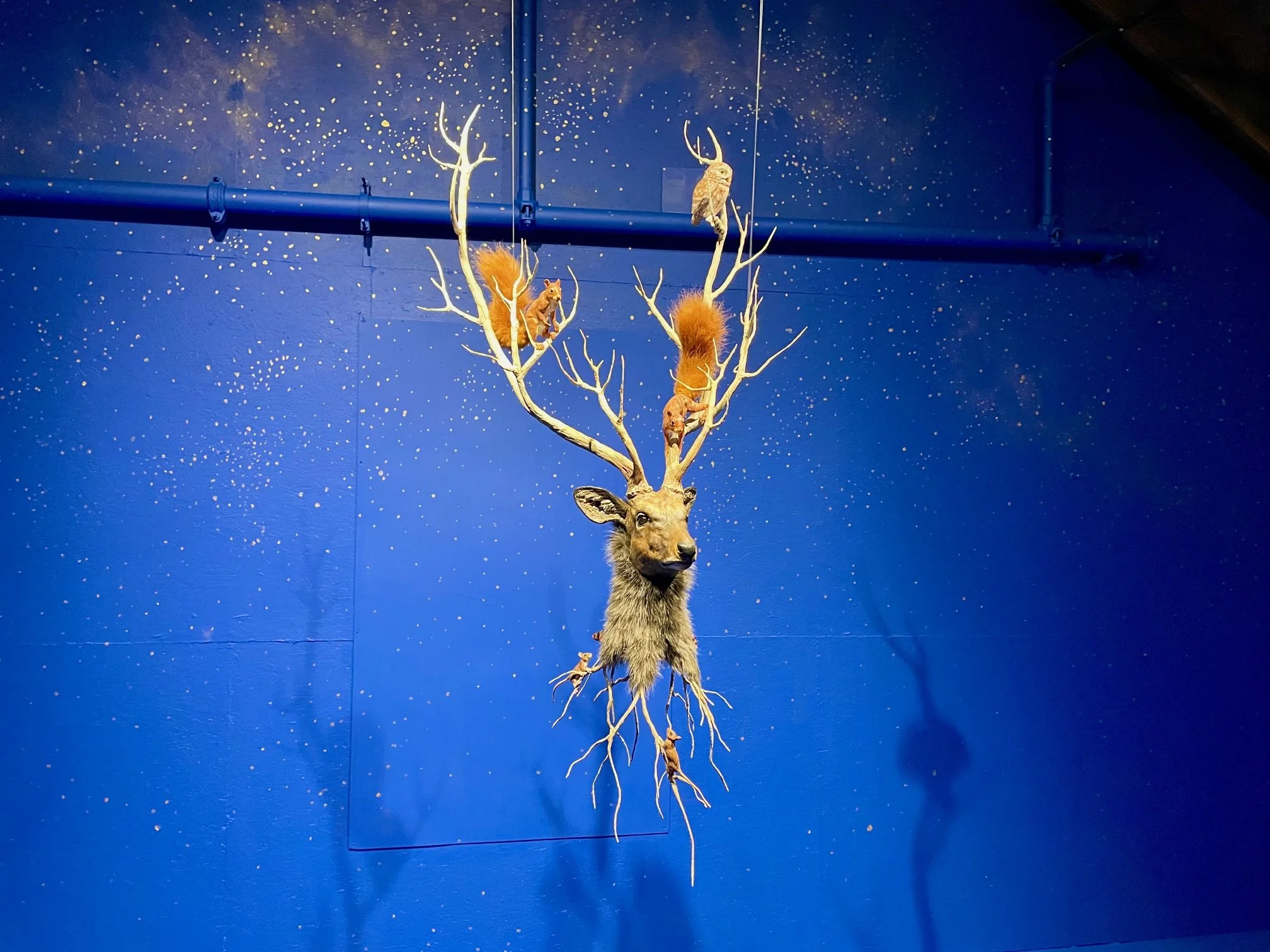
Installation view, This Must Be The Place, 2025, showing work by Deborah Simon; Photo David Ebony.
Every viewer will have a personal response to the works on view here, of course, and all the artists here are clearly accomplished. For me, though, two displays were the most outstanding and unforgettable. Kim Mullis’s series of abstract paintings on canvas tarps, stretched with long strings attached to grommets, were unapologetically gorgeous. They hint at Native American motifs and have the look of stretched hides. The paintings, however, are hard-edge, hallucinatory compositions made of colorful swirling forms and connected geometric shapes with which Mullis imparts a unique and exhilarating cosmology. The exhibition culminates in an arresting display in a celestial, blue-painted room at the uppermost gallery filled with Deborah Simon’s sculptures of deer, rabbits, squirrels and birds, made of polymer, epoxy, crystal beads, embroidery and paint. The installation conjures a mythological realm inhabited by forest dwellers while also addressing the ever-volatile relationship these creatures have with humankind. —David Ebony