
CARLOS VEGA: ANIMA MUNDI, WATTS PER LUMEN, and DEIRDRE O’CONNELL: NEW PORTRAITS.
CARLOS VEGA: ANIMA MUNDI at Jack Shainman Gallery, NY, NY, through April 18, ‘26.
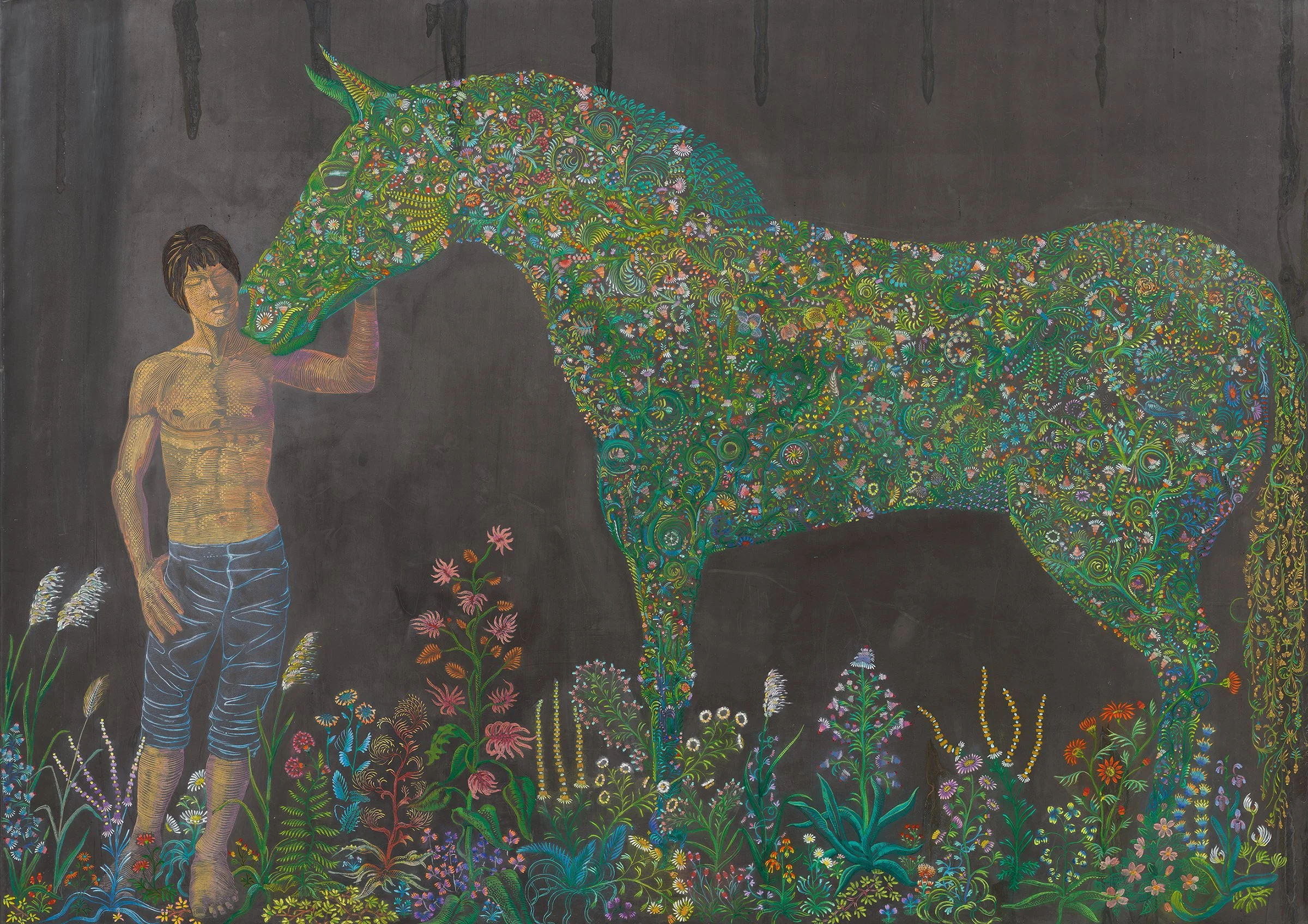
Carlos Vega, Levi, 2025, oil on lead panel. © Carlos Vega. Courtesy of the artist and Jack Shainman Gallery, New York. Photo: Dan Bradica Studio.
By any human measure, stars die slow deaths. After their golden years, known to astronomers as the “main sequence,” each sun exhausts its core of hydrogen fuel and becomes a red giant, burning brightly and expanding for a billion years before collapsing at last. This phenomenon is just one the celestial metaphors at play in Anima Mundi, Carlos Vega’s solo exhibition of mixed-media works on lead at Jack Shainman Gallery’s Chelsea location. In the artist’s painting of a Red Giant (2025), the titular star is fantastically rendered as a globe of convectional licks, its tropical hues of orange, green, and blue twinkling and roiling against the metallic substrate. Across the solar surface, amorphous cutouts reveal color photographs of mid-century celebrities, cheesing in all their airbrushed brilliance—another kind of star, if you will, likewise destined to disappear in time. If something so supernal as a sun in the sky must burn out and fade away, what can be said about these avatars of humanity, famous for but a fleeting moment? What of our own relatively small tenures in time and space? The exhibition text explains that to Vega, “there is safety within the guaranteed anonymity of the cycles of time.” In juxtaposing stars with stars, his paintings celebrate ephemerality as the universal privilege of existence.
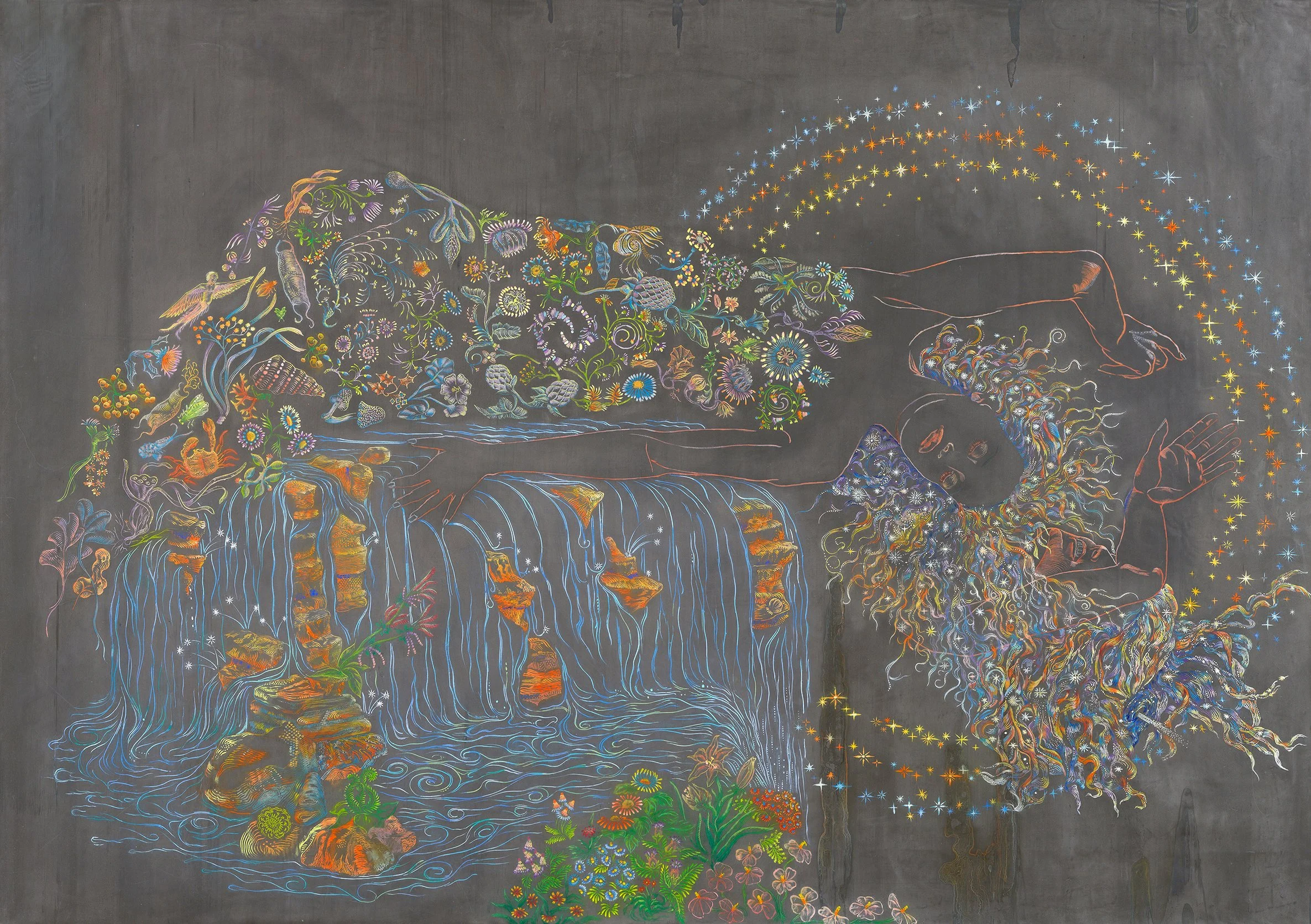
Carlos Vega, Gea (Gaia), 2025, oil on lead, mounted on aluminum panel with a stainless steel frame. © Carlos Vega. Courtesy of the artist and Jack Shainman Gallery, New York. Photo: Dan Bradica Studio.
Vega’s exploration of the heavens in Anima Mundi reaches beyond cosmic bodies. Deities populate the exhibition as humans and animals composed of abundant earthly beauty, as if to suggest that even gods are subject to the natural caprices of growth and decay. Gea (Gaia), 2025, imagines Mother Earth embodied as a tapestry of exotic flowers, insects, crustaceans, and stardust, lying in repose as her glistening mane cascades alongside the waterfall she sleeps upon. The verdant horse-god profiled in Levi (2025) is formed of a similar magic, nuzzling its shirtless, jorts-sporting friend with a muzzle of densely braided flora, wild as the meadow underfoot. The show’s smallest works appear like scientific studies of otherworldly blossoms, isolated against the unadorned lead ground with Latinate labels explaining what’s what. There is an entire universe contained in Vega’s exhibition—from the epic galaxies whirling with cultural idols to the critters perched on the petals of these enchanting flowers—held together by the singular and highly improbable joy of being alive. — Matt Moment
WATTS PER LUMEN at The Dorsky Museum of Art, SUNY, New Paltz, NY, through July 12, ’26.
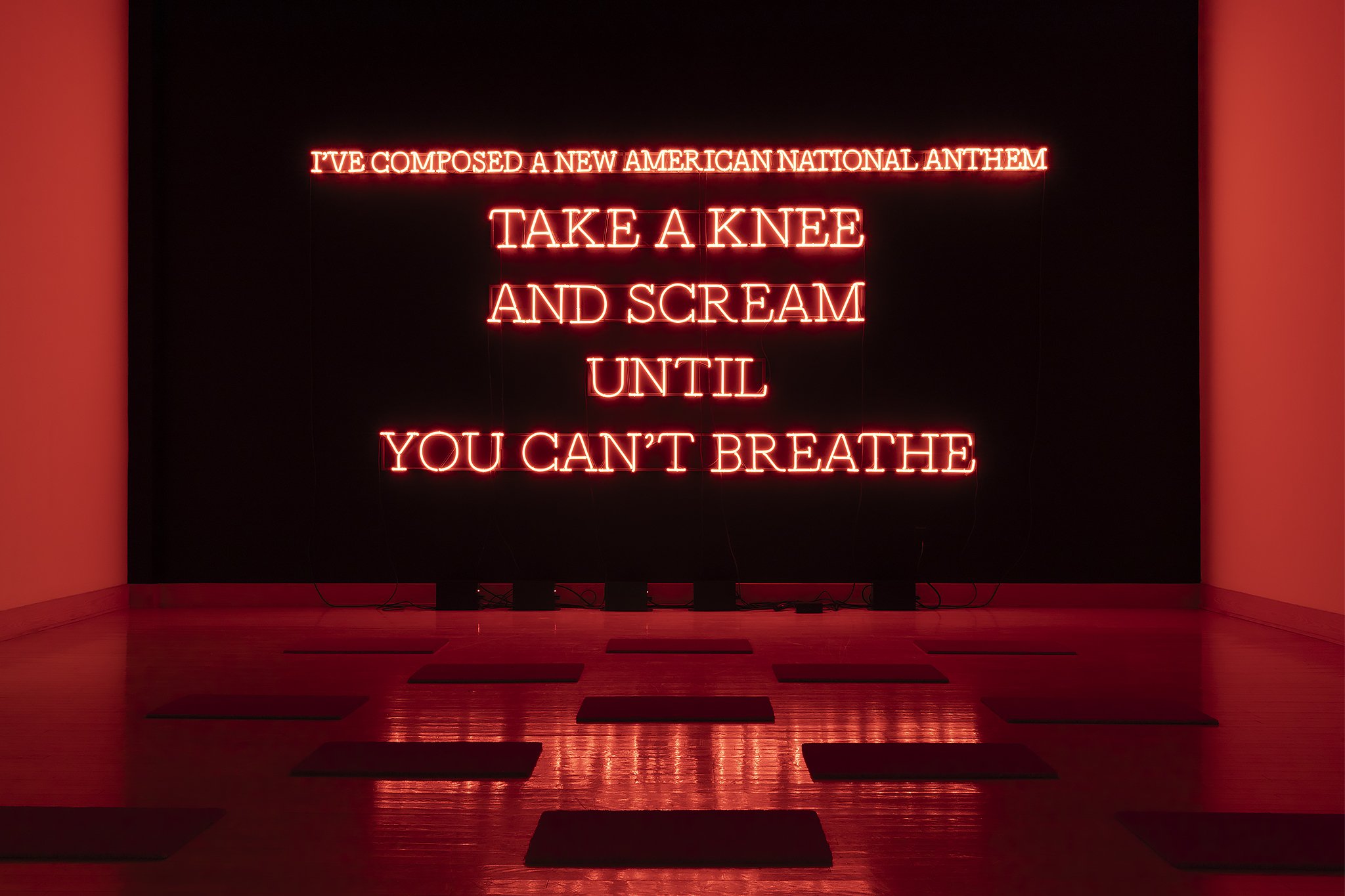
Installation view of Watts per Lumen at The Samuel Dorsky Museum of Art, showing Nicholas Galanin's Neon American Anthem (red), 2023; courtesy The Samuel Dorsky Museum of Art. Photo Mindy McDaniel.
Watts per Lumen is an idiosyncratic but exhilarating survey exploring the use of light in recent art. Organized by museum curator Sophie Landres, the exhibition was inspired by the Dorsky’s recent acquisition of works by Glenn Ligon, including pieces related to his celebrated neon work, Warm Broad Glow (2005), in MoMA’s collection, with the wall-mounted neon lettering “negro sunshine” painted black on the front and with stark white light glowing against the wall behind. The Dorsky’s two-dimensional Warm Broad Glow (Reversed), 2008, is an image of the original sculpture printed as a negative. As Landres notes, “Translating it into a medium in which light and dark switch positions continues the chromatic role-reversal initiated by painting the neon letter fronts black. The gesture further questions cultural habits that treat whiteness like an invisible original state against which blackness is seen as difference.” A similarly politically provocative and arresting work here, Neon American Anthem (red), 2023, by indigenous American artist Nicholas Galanin, is one of the exhibition’s highlights. Occupying one large gallery, the installation features a wall with glowing red neon texts in all caps reading, “I’ve composed a new American National Anthem / Take a knee and scream until you can’t breathe.” The words are an amalgam of Black Lives Matter slogans referencing the chokehold murder of Eric Garner at the hands of a New York police officer in 2014, and NFL quarterback Colin Kaepernick’s gesture of kneeling during the national anthem to protest racial injustice and police brutality. Galanin has provided floor mats on which gallery visitors are invited to kneel and voice their own protests by screaming at the top of their lungs until they cannot breathe.
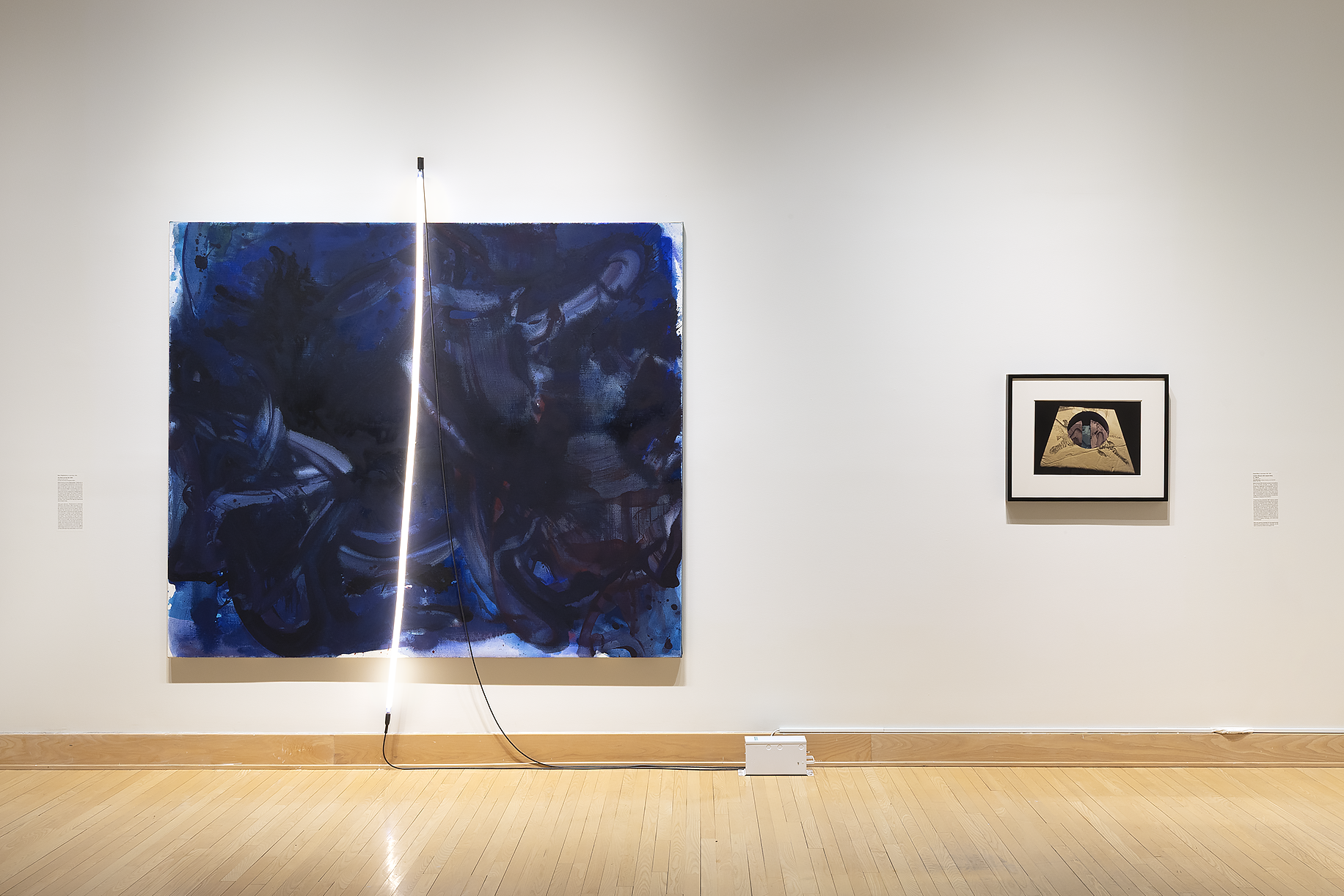
Installation view of Watts per Lumen at The Samuel Dorsky Museum of Art, showing works by Mary Weatherford (left), and Darrel Ellis (right); courtesy The Samuel Dorsky Museum of Art. Photo Mindy McDaniel.
Elsewhere in the exhibition, Landres engages with an exploration of the phenomenological properties of light and its philosophical relationship to the Enlightenment as a metaphor for truth. One of Mary Weatherford’s large, resplendent abstract canvases on view here, The Wind and the Sail (2023), for instance, features expressive brushwork in predominately deep blue tones. Vertically bifurcated by a white neon tube, the composition imparts quite literally a radiant aspiration toward the sublime. Among other surprises in the show, the late Greek-American artist Chryssa, known for her adventurous neon constructions, is represented here by PILL (1967), a non-light-emitting work featuring a blue plexiglass box containing clusters of glass tubes spelling the word PILL, in reference to the then-recent introduction of the FDA-approved birth control pill. This striking work depends solely on exterior illumination. With other more abstract and esoteric examples by artists including LJ Roberts, Nikita Gale, Rosemarie Trockel, Darrel Ellis, Rob Pruitt, Mary Ellen Carroll, Leslie Hewitt, and Anthony McCall, along with an outdoor neon wall sculpture by Erika deVries, Watts per Lumin underscores the practically limitless possibilities of light as a viable and evocative artistic medium. — David Ebony
DEIRDRE O’CONNELL: NEW PORTRAITS, at Susan Eley Fine Art, Hudson, NY, through April 26, ’26.
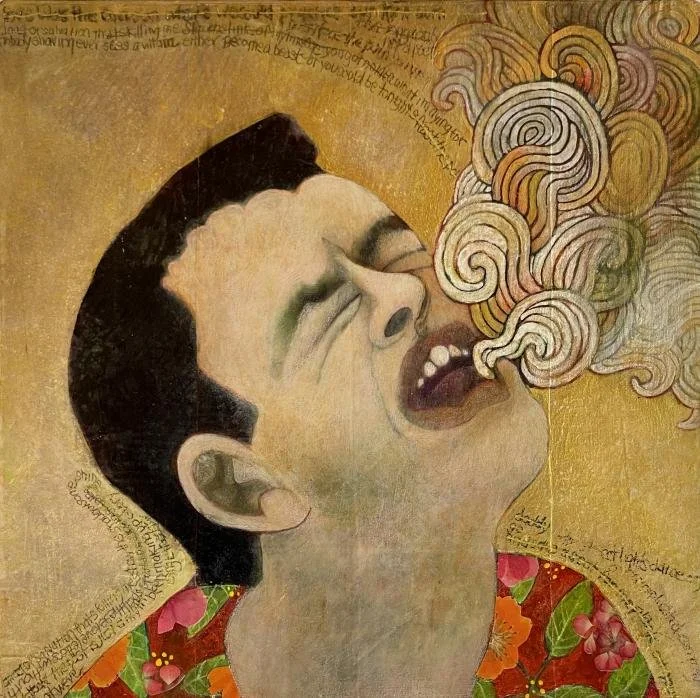
Deirdre O'Connell, Bobby #3 (2026); mixed media on wood panel. Photo courtesy Susan Eley Fine Art.
In her meticulously rendered painted portraits, Deirdre O’Connell shares with viewers an intimate relationship with each of her subjects that transcends their mere physical resemblance. The artist, also a Tony-award winning actor, creates images of friends and work colleagues in the midst of spontaneous gestures or activities that highlight their fierce individuality and unique personae. For instance, the quartet of striking portraits (intended for an album cover) of her musician and performer friend Bobby Moreno, suggests moments of performative action, like singing. In Bobby #3, the act of vocalization is rendered by means of elaborate patterns of spiraling lines that emanate from the mouth of the figure’s expressive upturned face. Meandering lines of scrawled text along the contours of the head and shoulders as well as the upper edge of the panel are borrowed from the lyrics of his songs. In Bobby #2, small, identical portrait heads are placed inside of the eye sockets of the face as if to suggest the multiple personalities that performers are routinely required to summon for their audience.
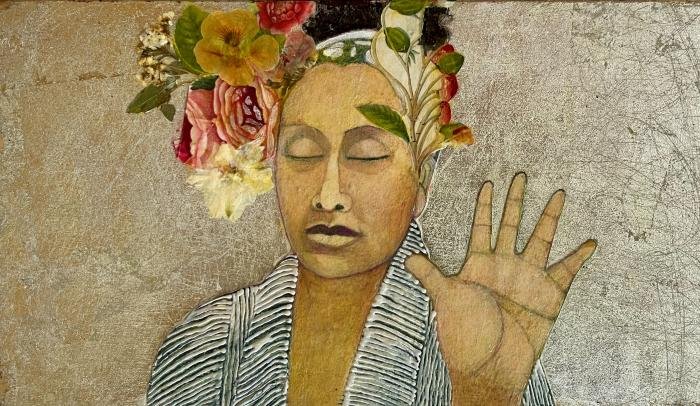
Deirdre O'Connell, Zoom #6: Nicole (2026), mixed media on wood panel. Photo Courtesy Susan Eley Fine Art.
O’Connell’s technique of dense layering of acrylic pigment, pencil, crayon, gold leaf and collage elements on wood panels, results in a refined palimpsest that at times recalls early Renaissance art. They also hint at works by certain Pre-Raphaelite painters—i.e., modest-scale compositions by Dante Gabriel Rosetti or Edward Burne-Jones. These art-historical allusions are especially strong in works that O’Connell creates for friends’ weddings, such as the female couple featured in Jenna, Banks, Mateo and Lucy, whose wedding gowns, embellished with glitter, lace and gold leaf, seen only from the back, convey a Baroque opulence. There is nothing retro or nostalgic about O’Connell’s vision, however, and she just as readily elicits comparisons to Francis Bacon or Frida Kahlo in her work. Several paintings on view were initiated during the pandemic and inspired by screen portraits of friends and colleagues during Zoom meetings. In the luminous Zoom #6: Nicole, for instance, O’Connell focuses on the sitter’s elaborate floral headdress that glows against a sliver-leaf background. The subject, with eyes closed, holds up her hand in an apparently spontaneous request to pause the proceedings or beg for a moment of quiet contemplation. — David Ebony