
Words Anna Godbersen Photography Chris Mottalini
Published in No 20
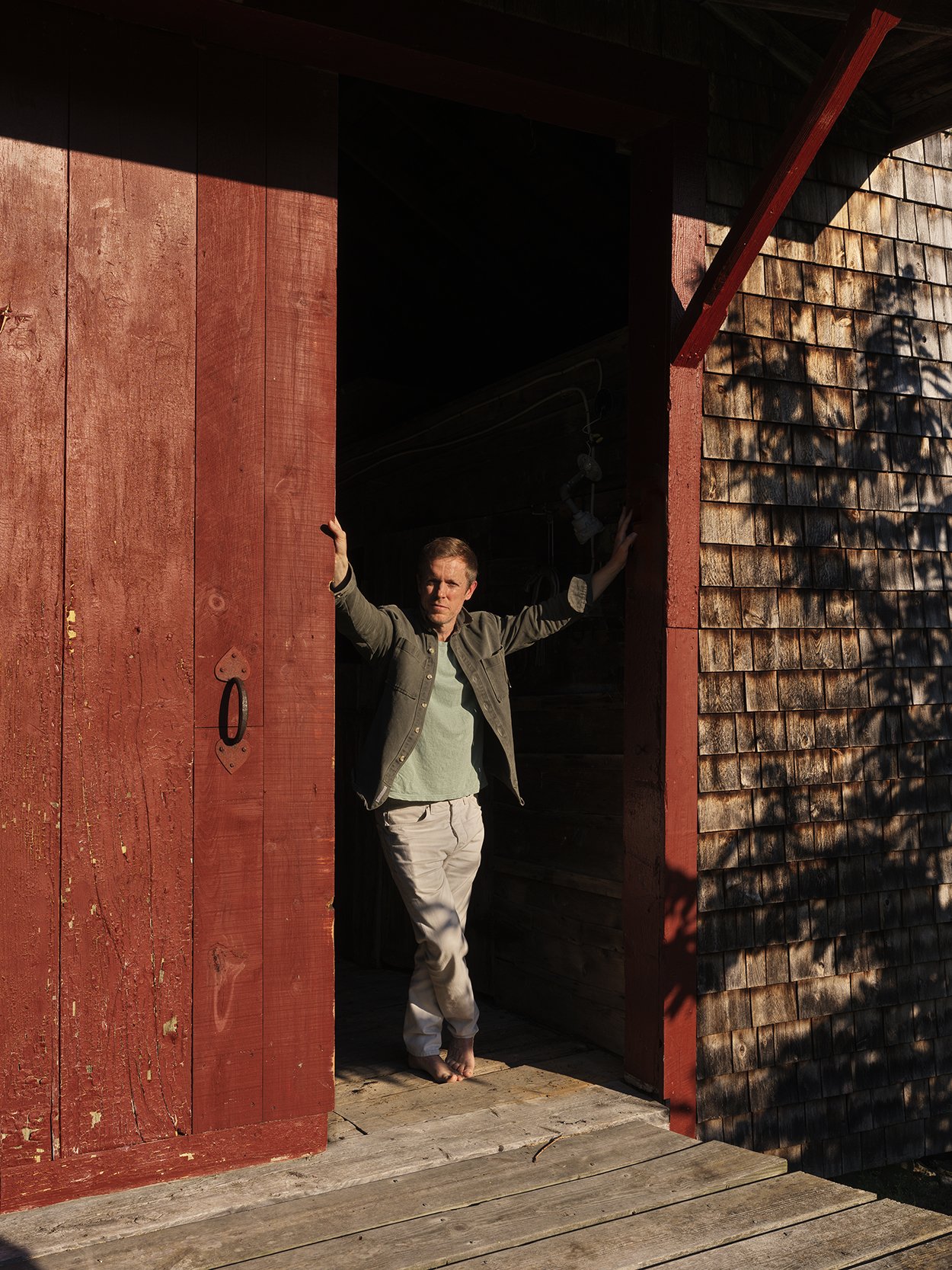
Scott LaStaiti stands in the doorway of the property’s old barn.
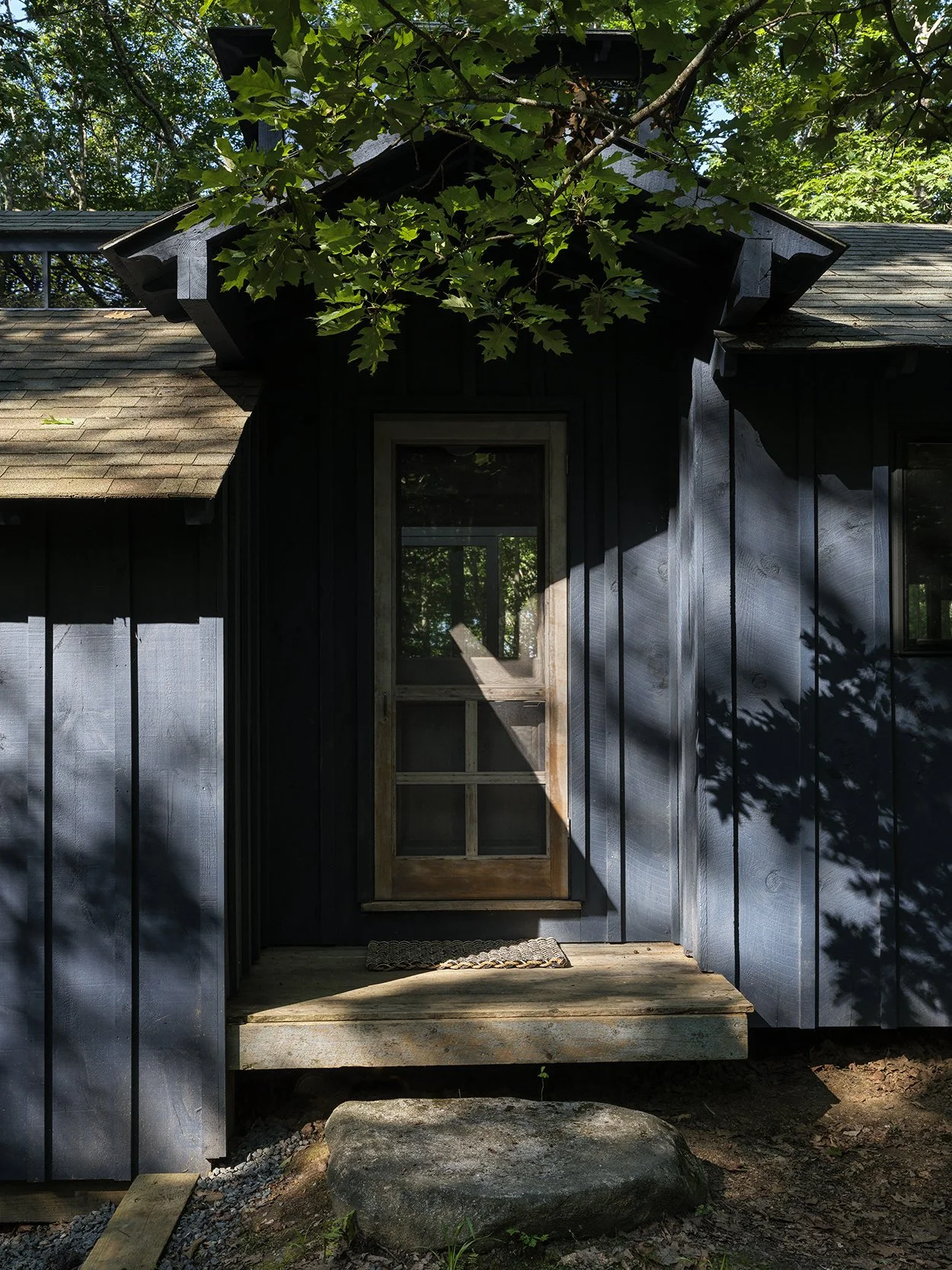
The main entrance to the three-season “writer’s cabin,” which was built without insulation in the 1970s.
“What happens to me when I cross the Piscataqua and plunge rapidly into Maine…?” wrote Charlotte’s Web author E.B. White, describing the drive from New York to his farmhouse on Blue Hill Bay in Brooklin, Maine; the experience was akin to “the sensation of having received a gift from a true love.”
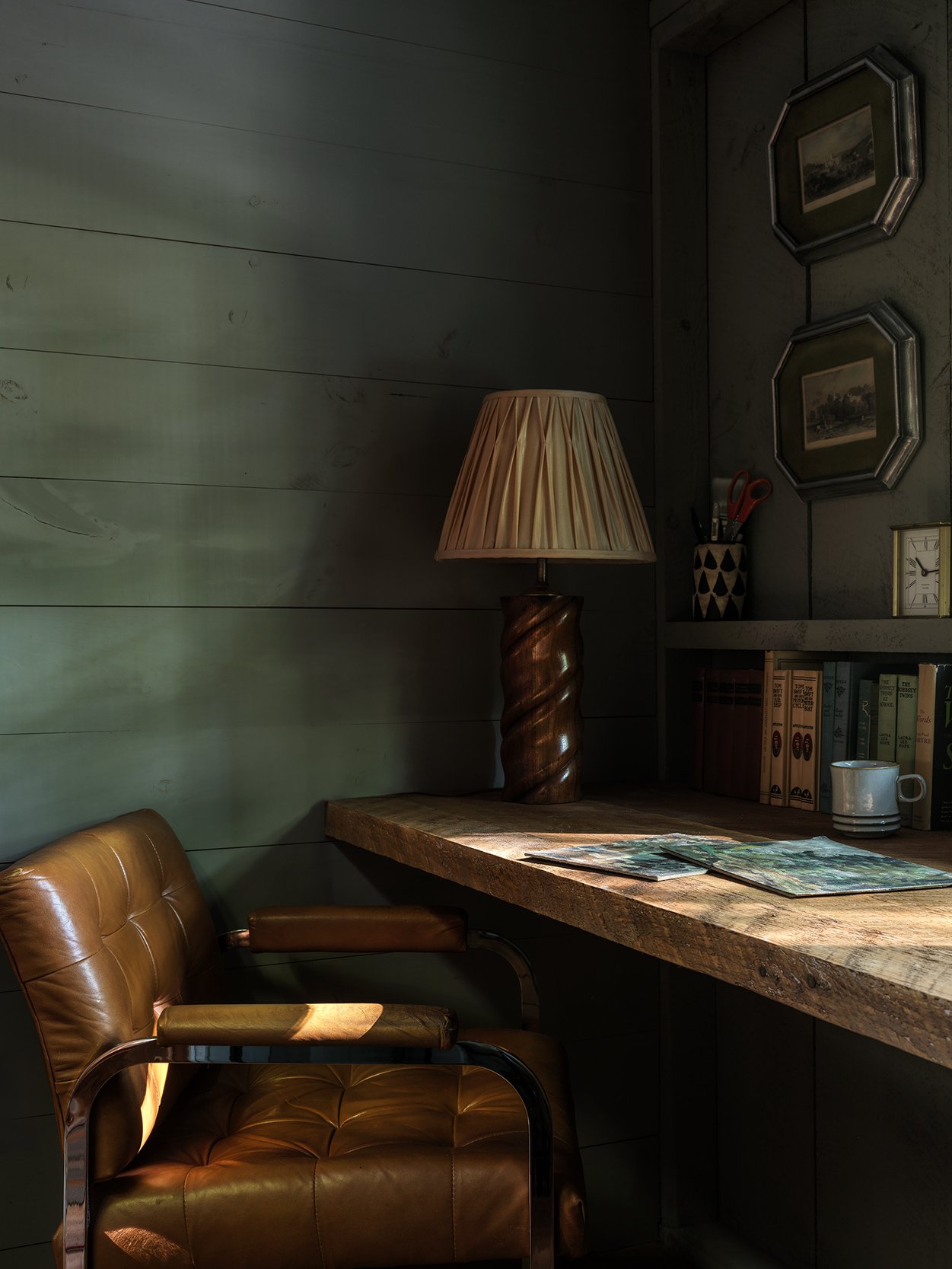
The writing room features a vintage lamp of carved wood and a Tiffany clock that belonged to the previous owner.
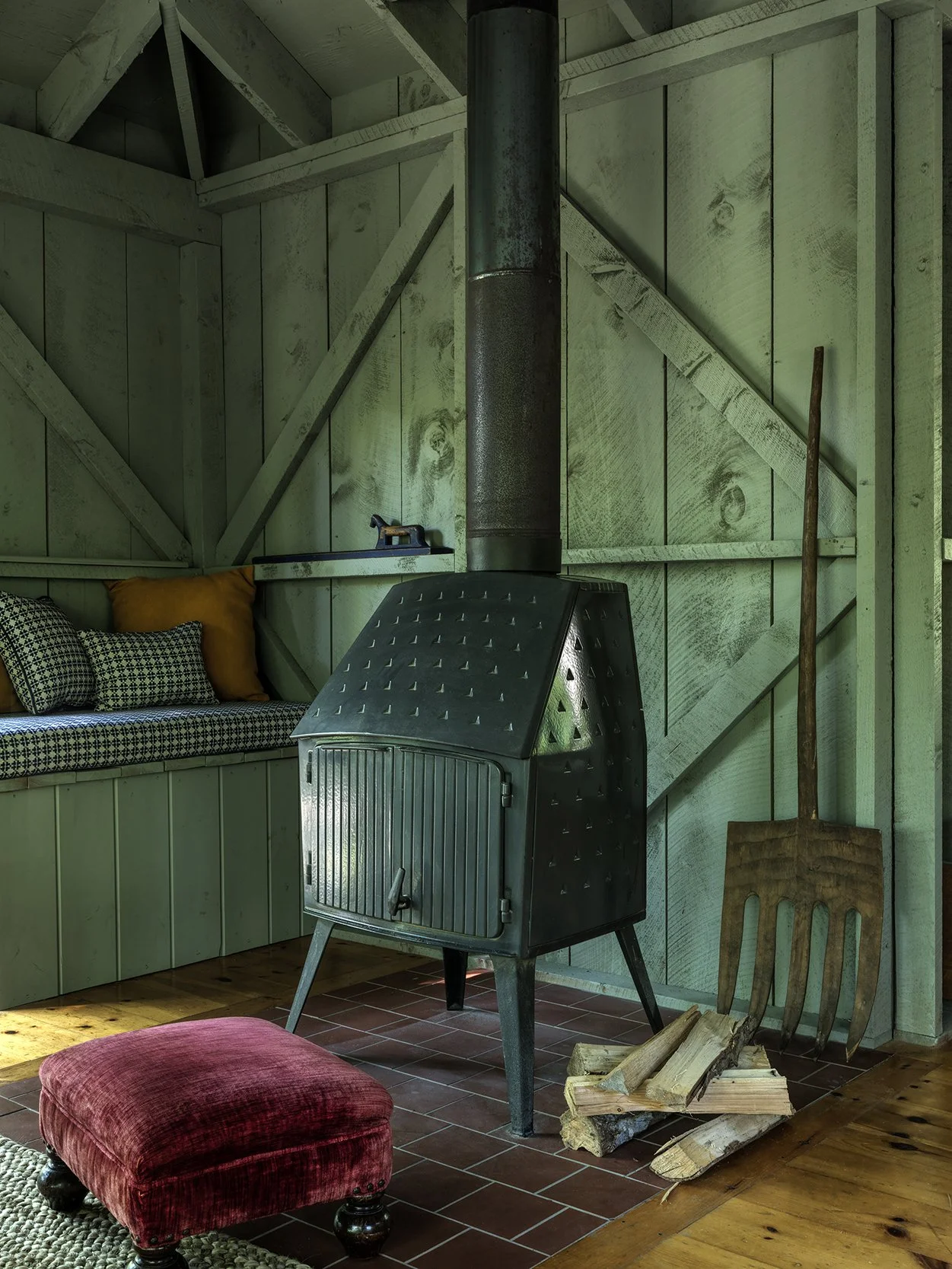
Featured in the living room is a vintage Morsø woodstove, and throughout the house the walls are painted in “Pigeon” by Farrow & Ball. All the cushions were custom made for the space.
Was that bracing shot of quaint New England purity what film producer Scott LaStaiti was chasing when he acquired an 1812 farmhouse a little further up Blue Hill Peninsula from White’s homestead, along with its outbuildings and surrounding acres? Not quite. LaStaiti knew of the area because his mother and her partner had retired there; he’d enjoyed visiting in late August, when summer is at its spectacular peak, and experienced idyllic early winter snow falls around Thanksgiving. But he considered himself lucky to be busy making movies on the West Coast (his recent credits include The Ministry of Ungentlemanly Warfare and Kandahar and the upcoming Paul Schrader film Oh, Canada). There wasn’t even a direct flight from Los Angeles to that part of Maine. Not until July of 2020, when L.A. was under lockdown and in the grip of an ominous heat wave did the weather and the boredom push him to imagine how nice it might be to go somewhere else. Maybe somewhere along a cool and rocky shoreline. This culminated in some intense real estate scrolling, which led to the discovery of an interesting property near his mother’s. His mother and her partner knew of this place — it had been owned by people called Ruth and Jim Modisette; their son J.M. had put it on the market awhile back — and offered to check it out. “There’s no harm in looking,” they said, a phrase any moviegoer knows will result in immediate and escalating complication. Anyway, they liked what they saw. LaStaiti boarded his first flight since the pandemic began. “I spent fifteen minutes on the property and fell in love with it. I felt there was limitless potential.”
The property, with its hundred acres and four thousand feet of waterfront, was in disrepair. “Nature had taken it back,” LaStaiti recalled. “It hadn't been lived in for a few years. There was this dock that looked a bit like a Dr. Seuss dock — you know, it was falling down. I needed a realtor, somebody to make an offer for me. The person I found was very excited about showing me a lot of properties, but my feeling was, ‘If I don't get it, I'm not going to look for another house in Maine.’”
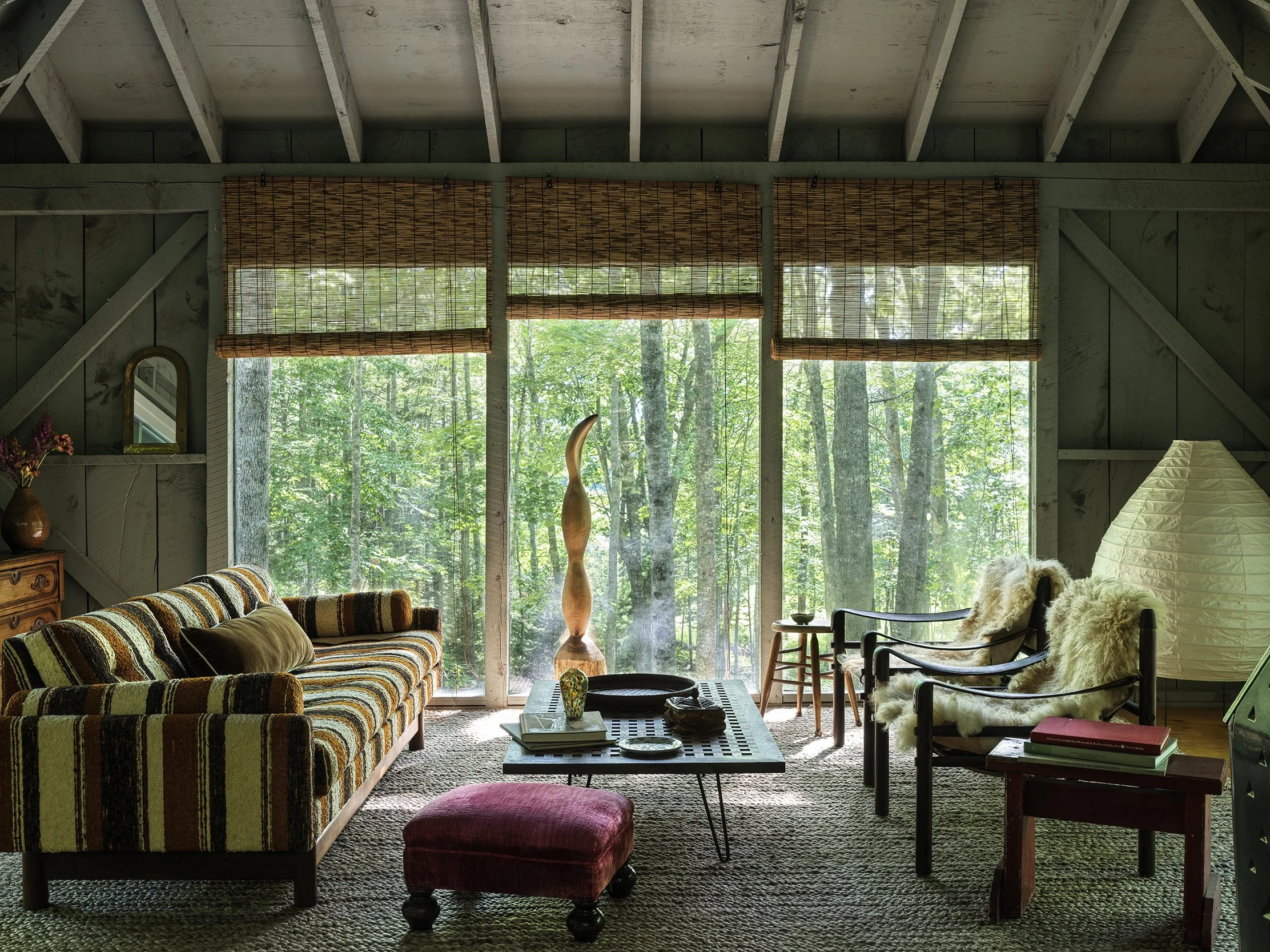
In the living room is a 1950s Adrian Pearsall sofa; another sculpture by Ettlinger; a pair of 1960s Colombian safari chairs by Arne Norell, covered in local sheepskin, and a Noguchi floor lamp (the only non-vintage item in the photo).
What ensued was an alchemy of vision and right timing. “At that moment I just happened to have a lot of time on my hands,” LaStaiti told me. With moviemaking, “I've been lucky that I've been really busy, but right then I wasn’t very busy. I think it speaks to what happens to me when I'm out here [in Maine]. I have time to get a little bored, and that leads to this openness, curiosity, ideas, and adventure. The opportunity came up when I had the bandwidth to consider it. [If it hadn’t been the early days of the pandemic] who knows if I would have even been sitting around in the middle of the day talking to my mom for an hour on the phone, and her telling me about her neighbor's house that never sold? It was just the perfect collision of events.”
As he began to take possession of the property, LaStaiti felt a bit like an archeologist, excavating “someone else's life, and someone else's family.” He had to sift through the furnishings left in the house in order to lay claim to the place, while preserving some of its history and vibe. He kept some of it, he told me — a candlestick, a pair of binoculars on the mantle and “a lot of the cookware and the silver, because what they did have was good, they had really good taste.” And there was also that residual aura of previous occupants, the people whose imaginations had shaped the property, and who are remembered by the surrounding community. “When you buy a house, you never directly meet the person you buy it from. You're dealing with brokers. But I hear people up here say J.M. was a great guy.”
Before the Modisettes came the Parrishes, distantly related to the artist and illustrator Maxfield Parrish (or so the story goes). It was a member of that family that cleared trees to create paths and open fields. LaStaiti estimates that sixty percent of the property is fields. “If people have a hundred acres in Maine, it’s usually woods. I have these big pastoral fields. It’s beautiful. And that has to do with the Parrishes. I'm lucky they did that.”
During the Parrishes’ tenure, two outbuildings went up, including the cabin that would become LaStaiti’s first renovation project. At the initial inspection, LaStaiti was advised these were teardowns, but his first encounter had convinced him otherwise. “It was such a romantic drive up to the cabin from the main house,” he said. He was still, at that point, taking in the scope of the large property, and it was “like an adventure to get there in the truck, heading off along the paths.” He had heard of a walking path that connected the main house and the cabin through the woods, and found evidence, too – "a broken-down old bridge with nails still sticking out of it that went over a brook.” He liked the idea of restoring it, so the quarter mile distance could be crossed on foot rather than by car.
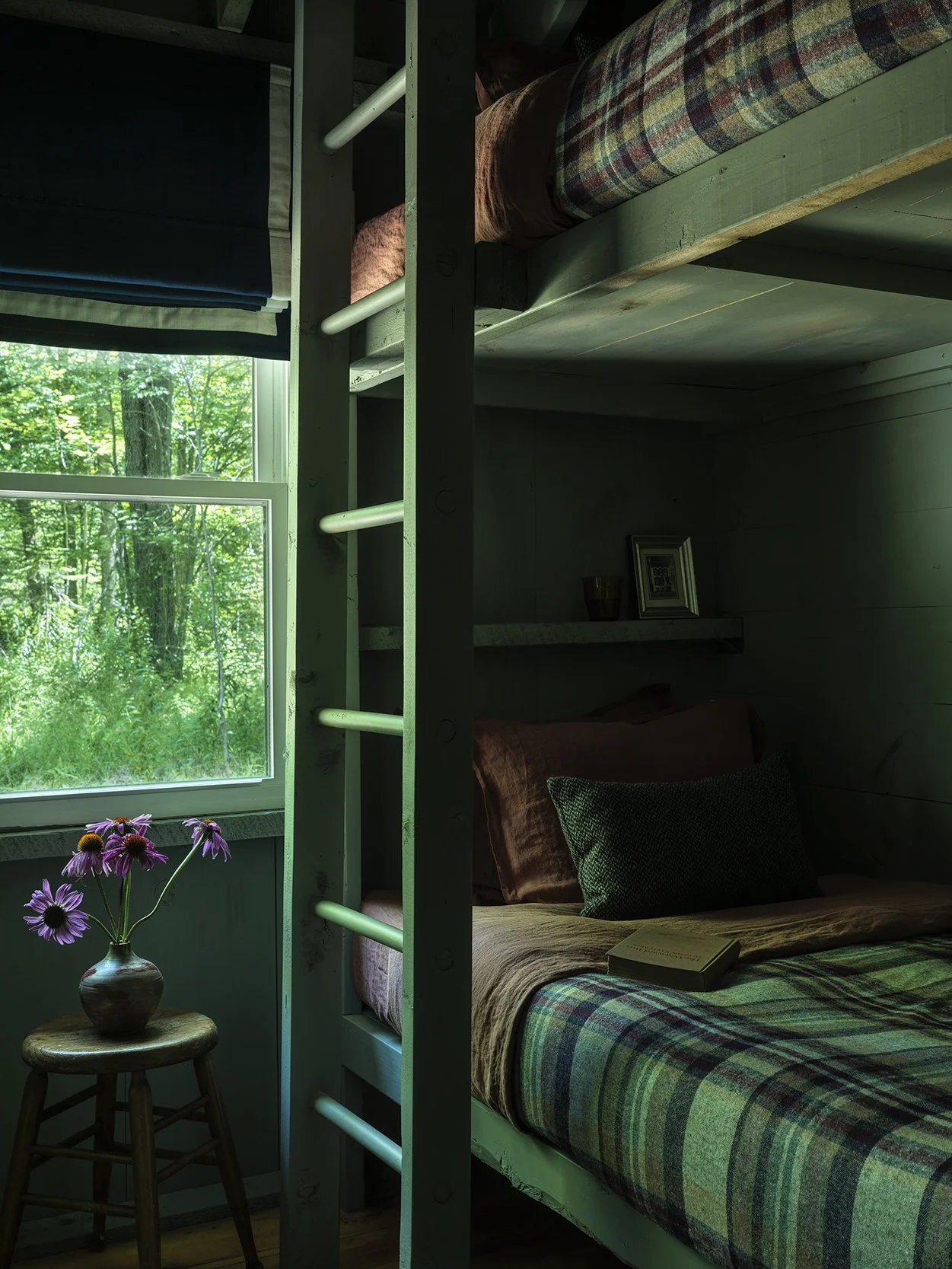
The bunk room is one of the cabin’s three bedrooms.
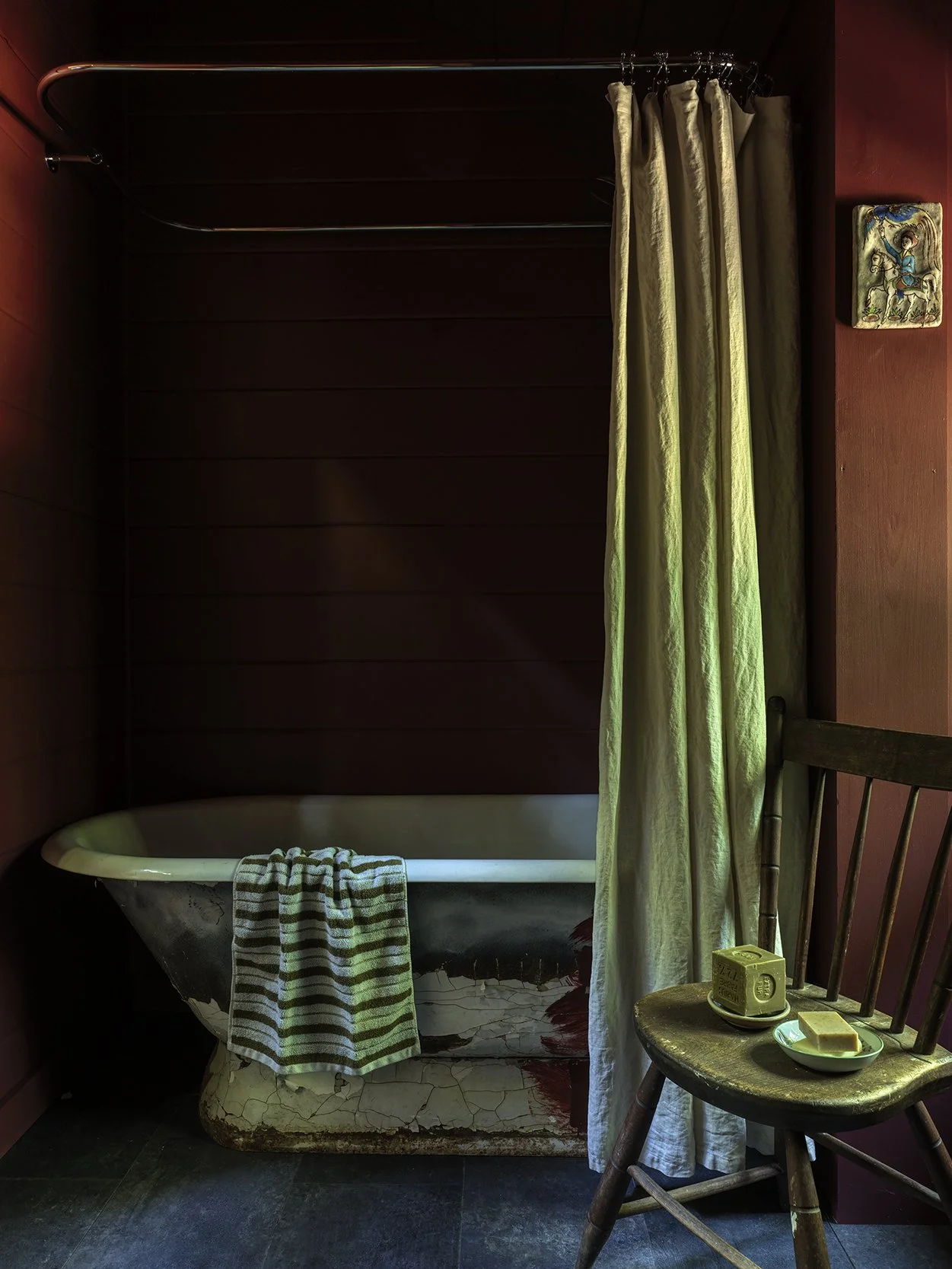
A reclaimed tub from Trash & Treasures found by Rousseau.
The provenance of the outbuildings are also lost to time, although one story goes that the Parrishes had a son-in-law who was an architecture student, and they let him design the two cabins, which probably went up in the 1970s. Initially, LaStaiti thought he would redo the cabin himself, but when it came time, he was filming The Accountant 2, and he realized that the renovation would be better served by a professional designer. The decision mirrors his filmmaking philosophy: “I find that so much of my professional life is creating a great environment for really talented people to work within, helping support and foster that environment, and then the project becomes something so much bigger than whatever I thought it could have been. I’m a director’s producer; movies are a director-driven medium. I’m part of that initial vision and inception — oftentimes it does start with me reading a book and thinking, ‘this would be a great adaptation’ — but then the question becomes, how can I bring in people who are better at doing their thing than I am?”
Through mutual friends he connected with Garance Rousseau, an L.A.-based interior designer, and found himself in a similar position of wanting to get out of the way and let her do her best work. The project appealed to Rousseau, who grew up partially in the Alps, where her family had a small cabin; the remoteness and wildness of coastal Maine was reminiscent of that simple, rustic life. Describing her initial impressions of the area, she said, “There’s no rush there.”
LaStaiti had already started working with Rich Marshall, contractor who fortuitously lives on the property, and Marshall and Rousseau took over the renovations, embracing LaStaiti’s preservationist impulse. “The walls are painted this kind of grayish green because they were rotted, and we had to protect them from the weather,” Rousseau told me. “But we kept the hallway totally original, and we sanded that down and refinished it.”
“Starting off on this project, Scott wanted it to be a little bit more modern, a comfortable, updated four season cabin. But I really thought that it deserved better, and I just asked him to take a chance on me and let me do what I thought was right.” This process was not without friction — Rousseau describes LaStaiti’s initial response to her choice of sofa — “it reminds me of my mother chain smoking cigarettes in the seventies,” — but he came around on that piece and gave Rousseau carte blanche. “He said, ‘do what you want, I trust you.’”
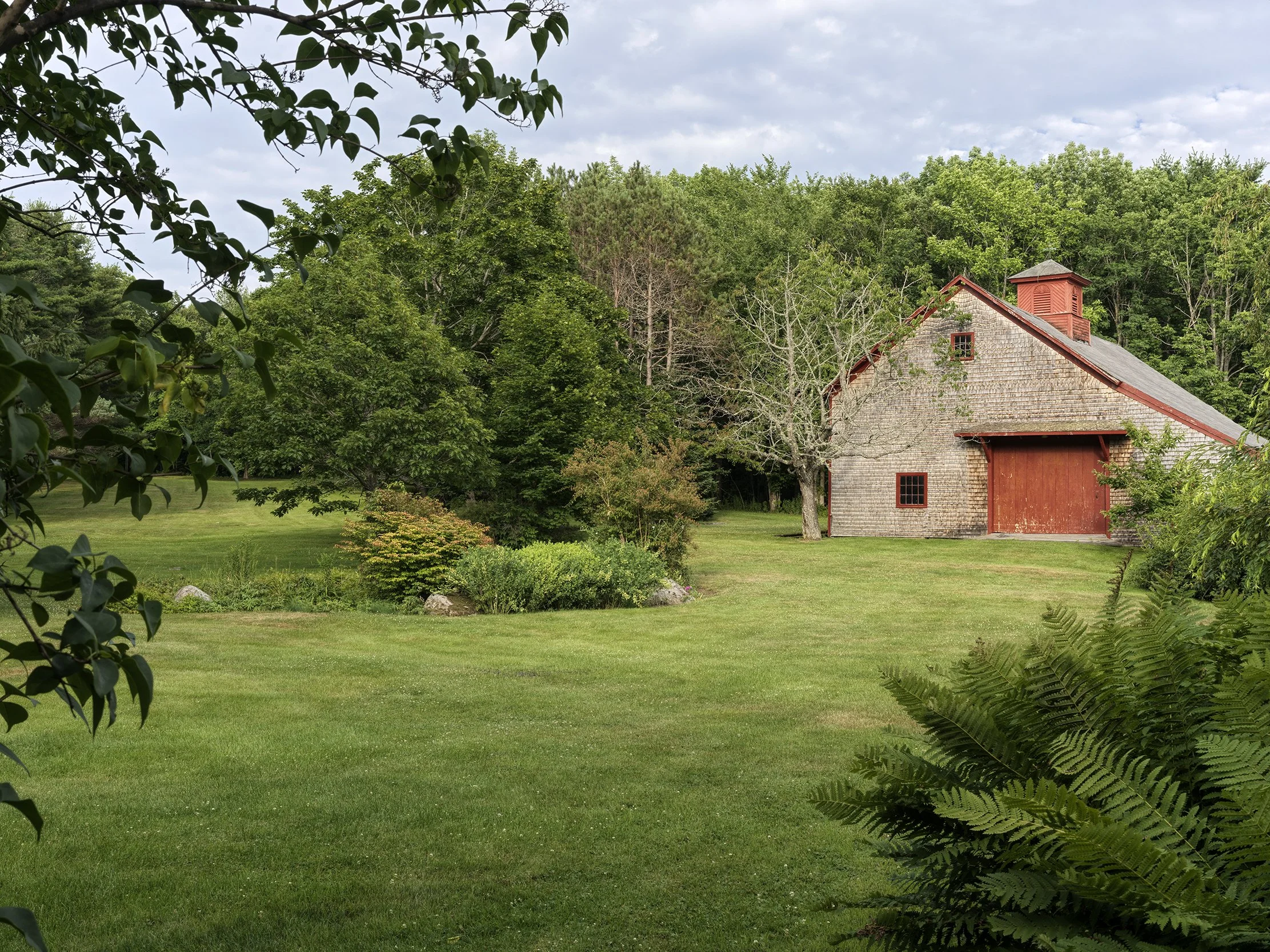
The former cattle barn.
The result was that Rousseau sourced nearly everything locally (“pieces that could feel a bit rougher but still be sophisticated”), including a cast iron tub with a burst of spray paint that Rousseau saw on the side of the road at a place called Treasures and Trash Barn. Along with these local finds, the rooms are studded with objects original to the property itself. “Garance was like, ‘I’d really love a clock,’” LaStaiti told me, “and there happened to be this old clock that had been in the house when I bought it and wasn’t in use, but I liked it, so I didn’t throw it out, and it turned out it was from Tiffany and had Jim Modisette’s initials engraved.” The story LaStaiti had been told was that “Jim loved the guesthouse, got really excited about opening it up for guests every summer. After he died, it just sat until the animals began to take it back.”
Jim’s clock sits atop the desk, built into a room that was once a closet, a sturdy plank beside a window from which one can see down to the water. “I want people to come here and write, feel like they can stay for six months and finish their novel or their screenplay.” The simplicity of the desk, and the nearby window, recall the iconic Jill Krementz portrait of E.B. White sitting at a handmade wooden table — typewriter, ashtray, window pulled upward to frame a view of the clam flats and presumably let in the salt air.
The guest house isn’t merely a romantically situated writing shack, however; LaStaiti sees the property as a “choose your own adventure kind of place.” When he’s there, he tries to swim every day, put his phone down, loaf and observe the wildlife — deer, hawks, bald eagles, frogs, moose, turkey, seals, and every possible form of waterfowl. When Marshall was married nearby, a bear was suspected of devouring the wedding cake (the bear was seen around with incriminating blue icing on its face). LaStaiti likes to host, let his visitors do their own thing. His friends run on the eight miles of paths through the fields and woods.
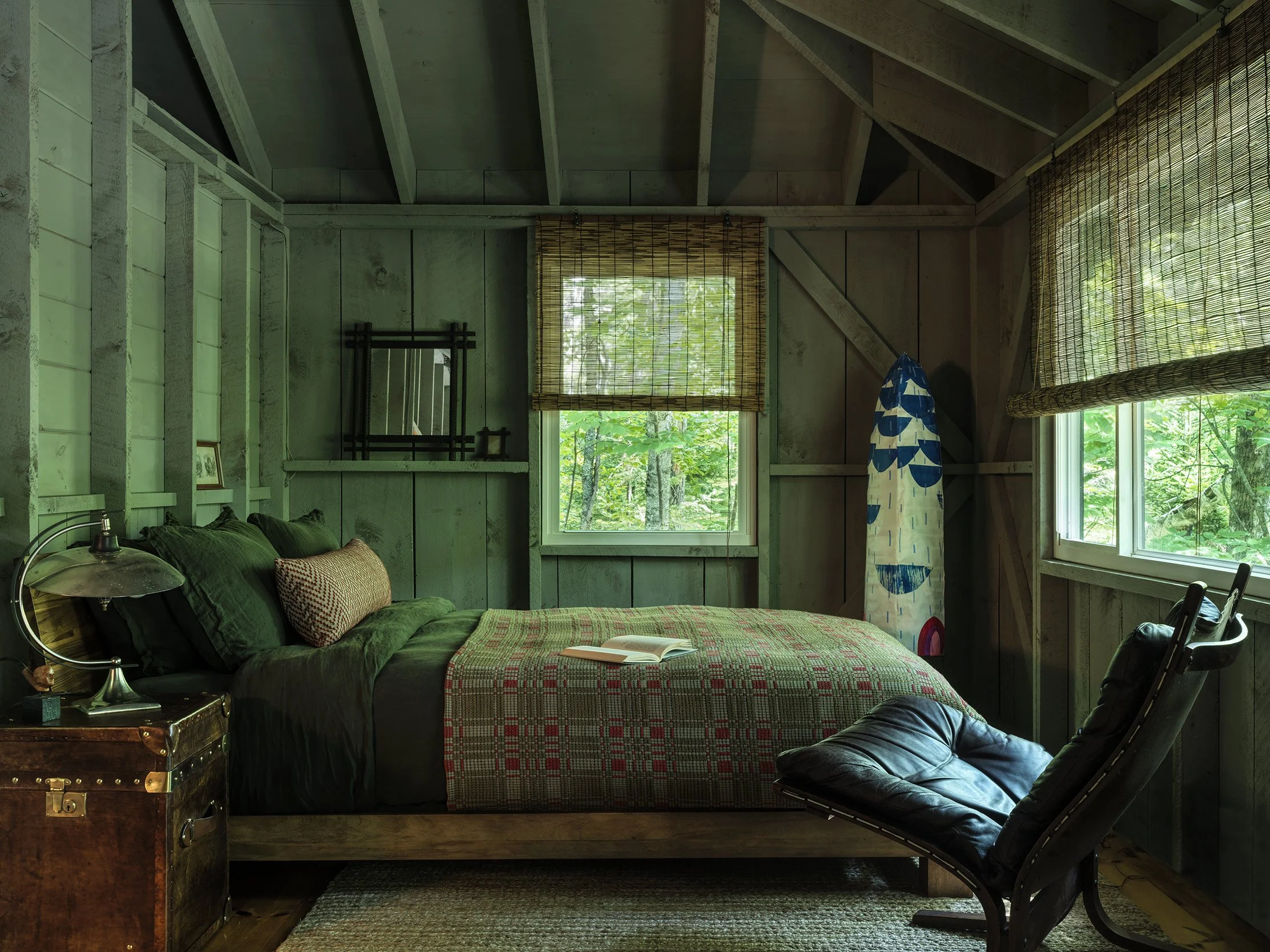
In the main bedroom, a 1960s Norwegian Siesta lounge chair by Ingmar Relling sits opposite a floor lamp by local artist Freddy Lafage.
It was on account of one of his writer guests that he managed to find the path that connects the main house and the restored cabin. After this friend departed, LaStaiti realized he had left a pair of his work gloves in her car, and asked if she was still in the area, if she wouldn’t mind putting them in his mailbox on the way out of town. When she swung by, she was with a friend who grew up on nearby Deer Isle. This friend of a friend came into the main house, appearing “slightly overcome with emotion.” She told LaStaiti, “It wasn’t until we turned onto the drive that I realized this was the house. I dated J.M. [Ruth and Jim Modisette’s son] for seven years, through high school and college.”
After listening to a few stories about the good times they’d had in the house, LaStaiti brought up the overgrown path he was trying to locate. “She stood at the dining room window with me, and said, ‘It was right about there.’ And then I could kind of see the entrance to it. So that put me on a mark. Later, when I got like thirty yards into the woods, I saw places through the trees that seemed like a natural path, and then I got to that broken down bridge over the brook.” This impulse to create an ideal environment for creatives to do their own thing had led him in a circuitous way back to what he was looking for. “Most of the leaves were off the trees, so once I got across the brook, I could see a straight shot all the way to the cabin…”
Writer Anna Godbersen and photographer Chris Mottalini are not only regular contributors to UD, but they have also been good friends for twenty years.