
MODUS OPERANDI, TOMASHI JACKSON AND ROBERT RAUSCHENBERG: THE CATCH ONE, PAINT YOUR LIFE!, and A LINE, A SHAPE, A TOOL.
MODUS OPERANDI, The School | Jack Shainman Gallery, Kinderhook, NY, through Nov. 28., ‘26.
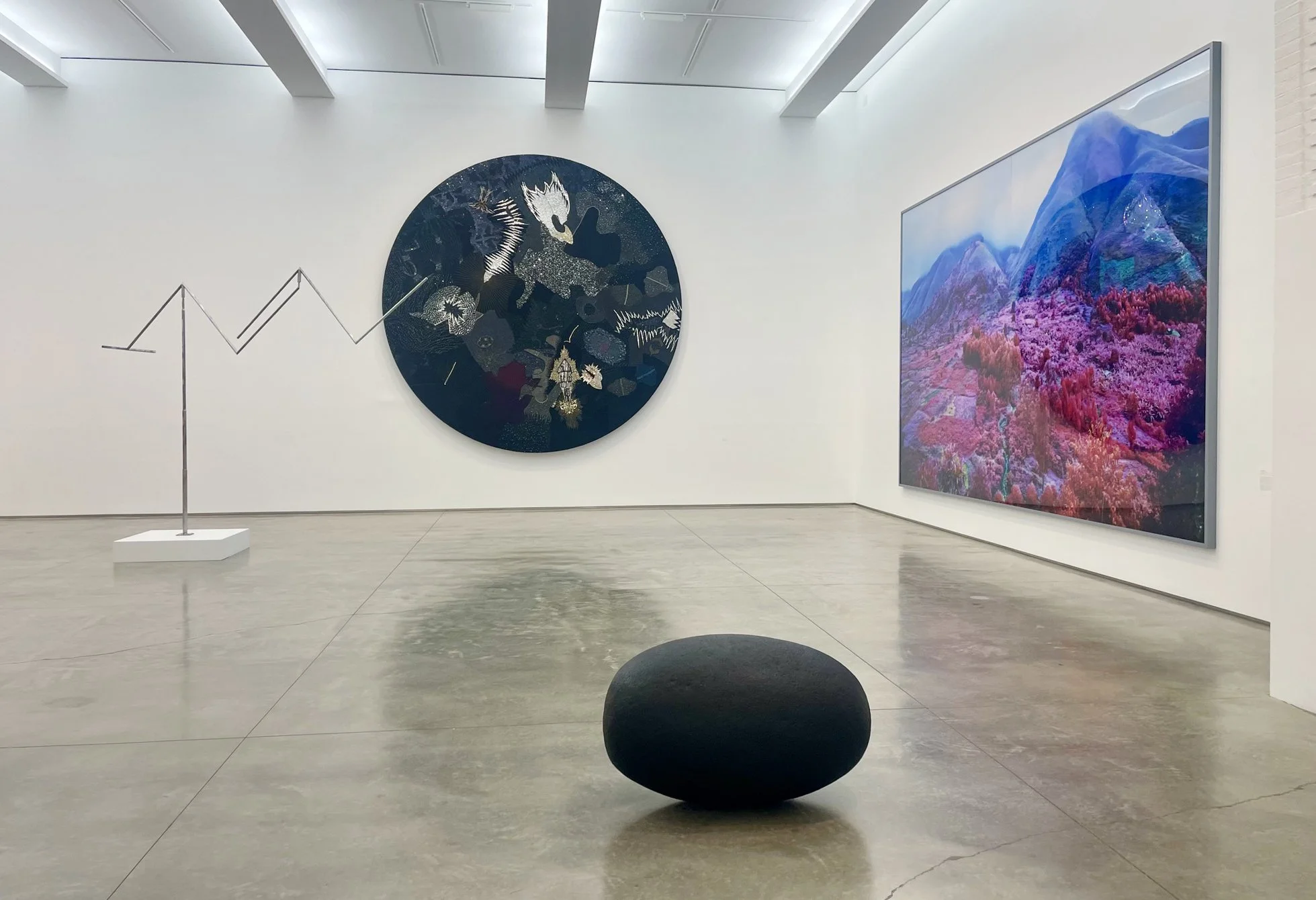
Installation view, Modus Operandi, showing works by (l-r) George Rickey, Nick Cave, Richard Mosse, and Wolfgang Laib (foreground), The School / Jack Shainman Gallery, 2026; photo David Ebony.
The title of this year’s season opener at The School, Modus Operandi, suggests an exhibition of works by artists unified by a similar means of working, or a closely related methodology. In fact, the works by nearly twenty artists are impressive and often stunning as a group due to the astonishing diversity in their methods. Nevertheless, there are some clear correspondences. The Ghanian sculptor El Anatsui, renowned for his wall reliefs of glittery woven bottle caps, for instance, is represented here by two superlative examples, including the large, irregular tondo Silver and Gold Have I Not (2023). Like a radiating orb, the circular composition spans some ten feet in diameter, with narrow rods or “tendrils,” as the artist calls them, projecting several more feet from the circumference, rather like laser beams. In terms of unorthodox materials and ultra-reflectivity, the mural-scale Requiem (Altarpiece), 2020-2022, by Cuban-born-artist Yoan Capote, at first appears from a distance to be a shimmering seascape. A monochrome gold-leaf sky causes the undulating ocean waves below to sparkle in a transfixing maritime hallucination. On closer inspection, the “waves” prove to be made of countless fishhooks, and Requiem suddenly transforms itself before the viewer into a moving meditation on the many fisherman and sailors from the island nation, and perhaps in more recent years, the many emigrants, who have lost their lives to the sea.
More playful intersections of theme and process appear in works by painters such as Alexis Rockman and Barry McGee, plus the sculptor Rose B. Simpson, who offer thoughtful mashups of didactic illustration (Rockman), graffiti intervention (McGee), and modernist assemblage (Simpson) in inspired works of figurative art. And Mark Dion’s eccentric dioramas, such as Packrat (2024) featuring what appears to be the large skeleton of a dinosaur, and Nick Cave’s room-size installation of black metal and cast-resin arm and wrists, Chain Reaction (2022-23), invite viewers into insular theaters of meditation with no set rules or fixed directives. Modus Operandi is especially memorable as a kind of curatorial correspondence between gallerists Jack Shainman and Angela Westwater of Sperone Westwater Gallery, whose stable of artists from the preeminent but now-shuttered New York venue align gracefully with artists long associated with Shainman.
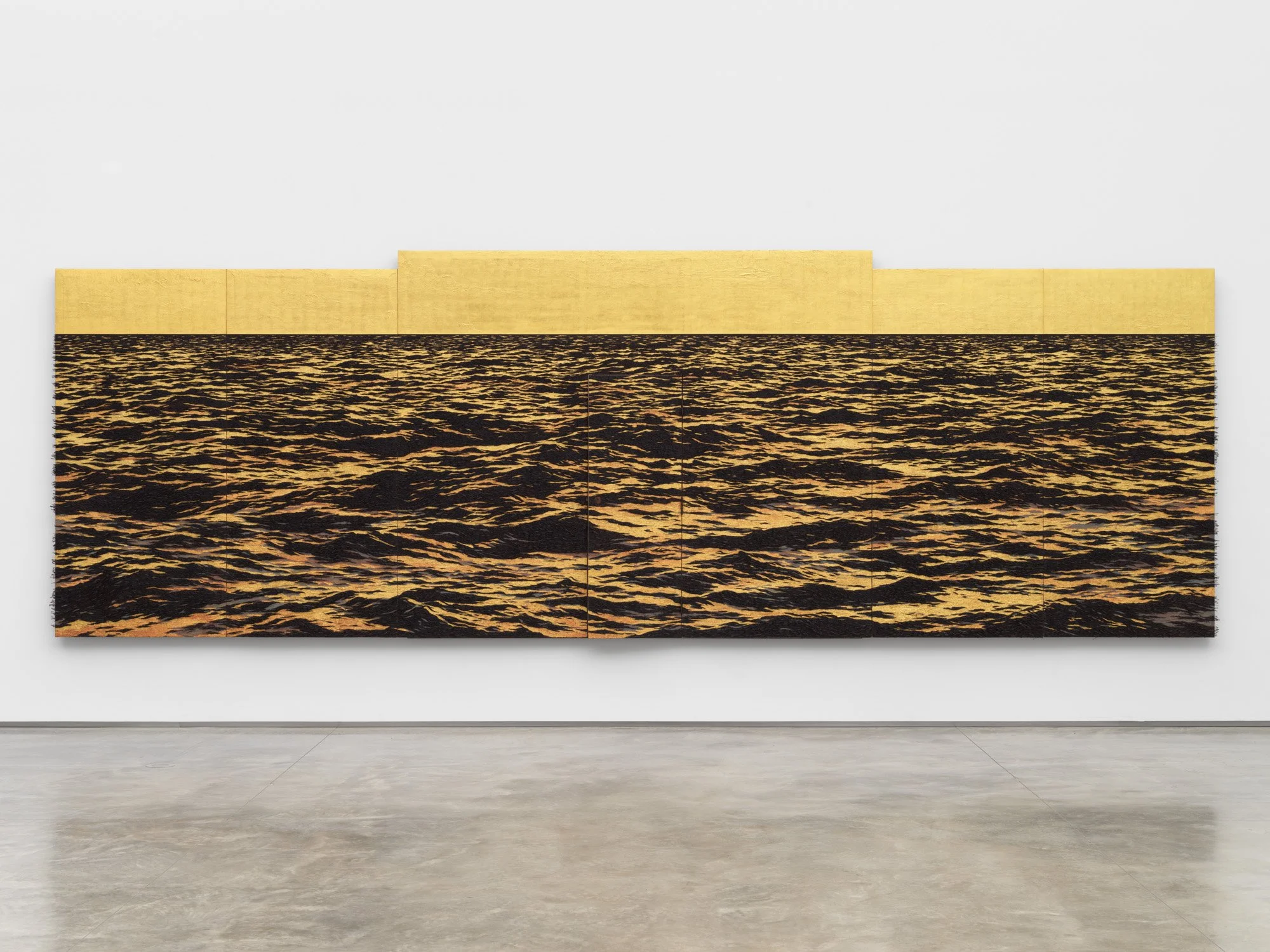
Yoan Capote, Requiem (Altarpiece), 2020-22; photo courtesy The School / Jack Shainman Gallery.
Among the wonderful aesthetic interactions within the show, the celebrated multimedia veteran Bruce Nauman, and sculptor and installation artist Wolfgang Laib, longtime Sperone Westwater staples, are each represented by a room full of representative, career-defining, if not career-spanning works. These artists explore many complex formal concerns shared by Shainman stalwarts such as the sculptor and installation artist Radcliff Bailey and photo artist Richard Mosse. Bailey explores the Black experience in America in works such as his arresting installation Western Coast—West Coast Slave Trade (2009-2018), made of piles of piano keys, while Mosse’s large, infrared and thermographic images of covert military operations have broad socio-political implications. Throughout the exhibition themes of community and the importance of human interaction recur, as in the unpopulated theaters and other public gathering places by Argentine painter Guillermo Kuitca and the lively and very-populated compositions by Botswana-born painter Meleko Mokgosi, including his multipaneled work Spaces of Subjection: Appellations (Addendum III), 2024, that recalls Picasso’s Family of Saltimbanques (1905) as a nuanced study of acrobatic performers; it is among the exhibition’s highlights. — David Ebony
TOMASHI JACKSON AND ROBERT RAUSCHENBERG: THE CATCH ONE at The Glass House, New Canaan, CT, through Dec. 14, ‘26.
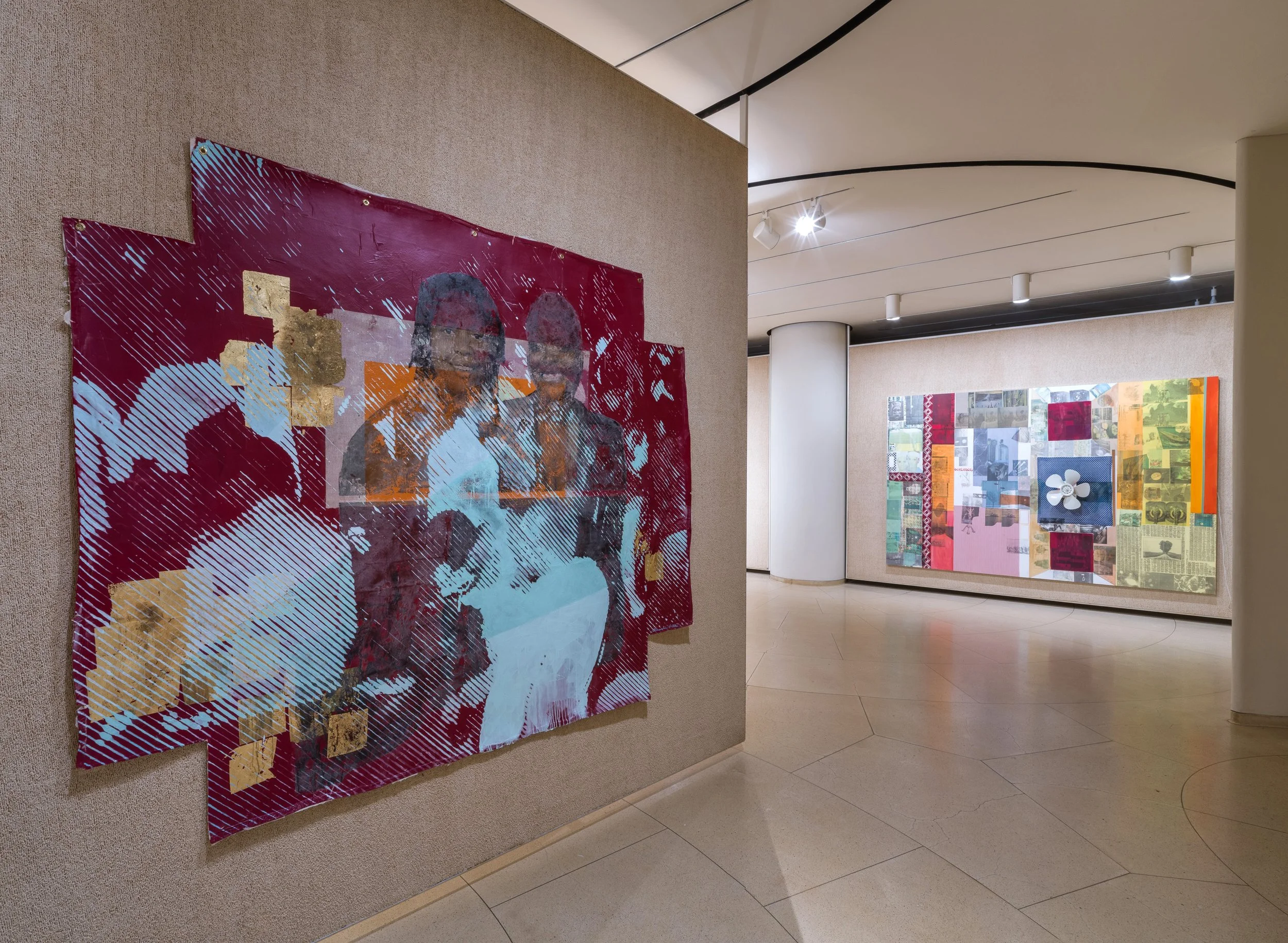
Installation view of Tomashi Jackson and Robert Rauschenberg: The Catch One at The Glass House, showing Tomashi Jackson (left) and Robert Rauschenberg (right); courtesy The Glass House. Photo David Heald.
A visit to The Glass House is a charmed experience, and even more so with the chance to see Tomashi Jackson and Robert Rauschenberg: The Catch One in the bunker-style Painting Gallery. Curated by Cole Akers and organized by The Glass House in partnership with the Robert Rauschenberg Foundation, the exhibition marks the centennial of his birth and brings together Jackson’s and Rauschenberg’s vibrant compositional styles into harmonious dialogue. Through his diverse explorations in painting, photography, printmaking, and performance, Rauschenberg’s enduring influence can be further admired through the work of current multimedia artists such as Jackson, whose explorations with layered content and the three-dimensional possibilities of painting are a stimulating reverberation of Rauschenberg’s creative methods. In 2025, Jackson did an artist residency with the Rauschenberg Foundation at his former home-studio in Captiva, Florida, which set the stage for this two-person show. The Catch One title references the name of a Black and lesbian-owned nightclub in Jackson’s native Los Angeles and highlights Jackson’s artistic reflections on the significance of ‘sanctuaries’ as welcoming spaces for queer communities. The expanded story of The Glass House reveals architect Philip Johnson’s life and career as a gay man, and indeed his flourishing acreage in New Canaan abides as a sacred space for all to enjoy.
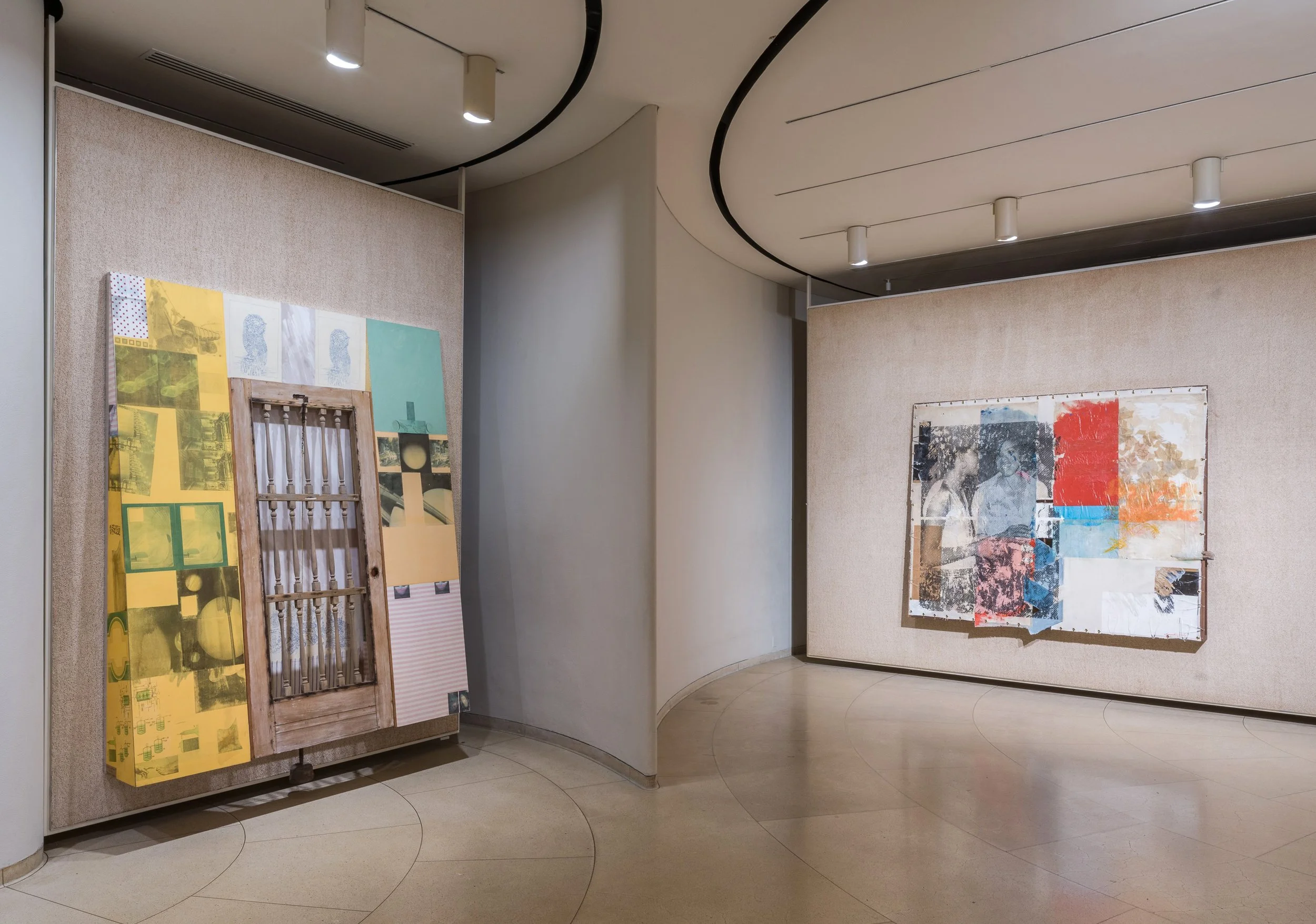
Installation view of Tomashi Jackson and Robert Rauschenberg: The Catch One at The Glass House, showing Robert Rauschenberg (left) and Tomashi Jackson (right); courtesy The Glass House. Photo David Heald.
The visual synergy between Rauschenberg and Jackson is a thrill to behold as their pieces take turns animating the gallery. In the vestibule, smaller works by Jackson include Untitled (Topeka Classroom on Rawhide) (2015) consisting of a silk-screened image of Black school children overlayed on a hunk of hairy animal skin, while Rauschenberg’s Black Tie Sperm Glut I (1987) features four assembled classic yellow and white road signs with directional arrows pointing willy-nilly. In the main room, Rauschenberg’s Recital (Spread) (1980) consists of a dense scene of patterned fabrics and solvent-transferred visuals from popular culture with an electric fan protruding forth from the middle. Nearby Jackson’s Constant Craving (Jewel Thais Williams and Friend at Jewel’s The Catch One, 1970s / Spottswood Thomas Bolling, et al., Petitioners, v. C. Melvin Sharpe, President of the District of Columbia Board of Education, et al. 1954) (2025) is an image of two Black women smiling brightly amid textured blocks of bold color with found wood from her time at Captiva. Across the room, another expert pairing features Jackson’s If You Were Here Tonight (Jewel’s Dance Floor in the 70s on Cupboard Doors from Our Home in L.A.) (2026) next to Rauschenberg’s Solar Elephant (Kabal American Zephyr) (1982), where both works include a door as a prime feature: for Jackson as a canvas, for Rauschenberg as an embedded element. The Glass House is a time-machine that can only be experienced in real-time and now is an opportune moment to seek the magic of this locale in conjunction with The Catch One. While Rauschenberg’s art upholds a monumental past, Jackson’s works are a contemporary embodiment of the recurrent themes—complexity, expression, freedom, joy—as explored by these two brilliant artists. –Taliesin Thomas
PAINT YOUR LIFE! at Leo Koenig Inc., Andes, NY, through July 26, ’26.
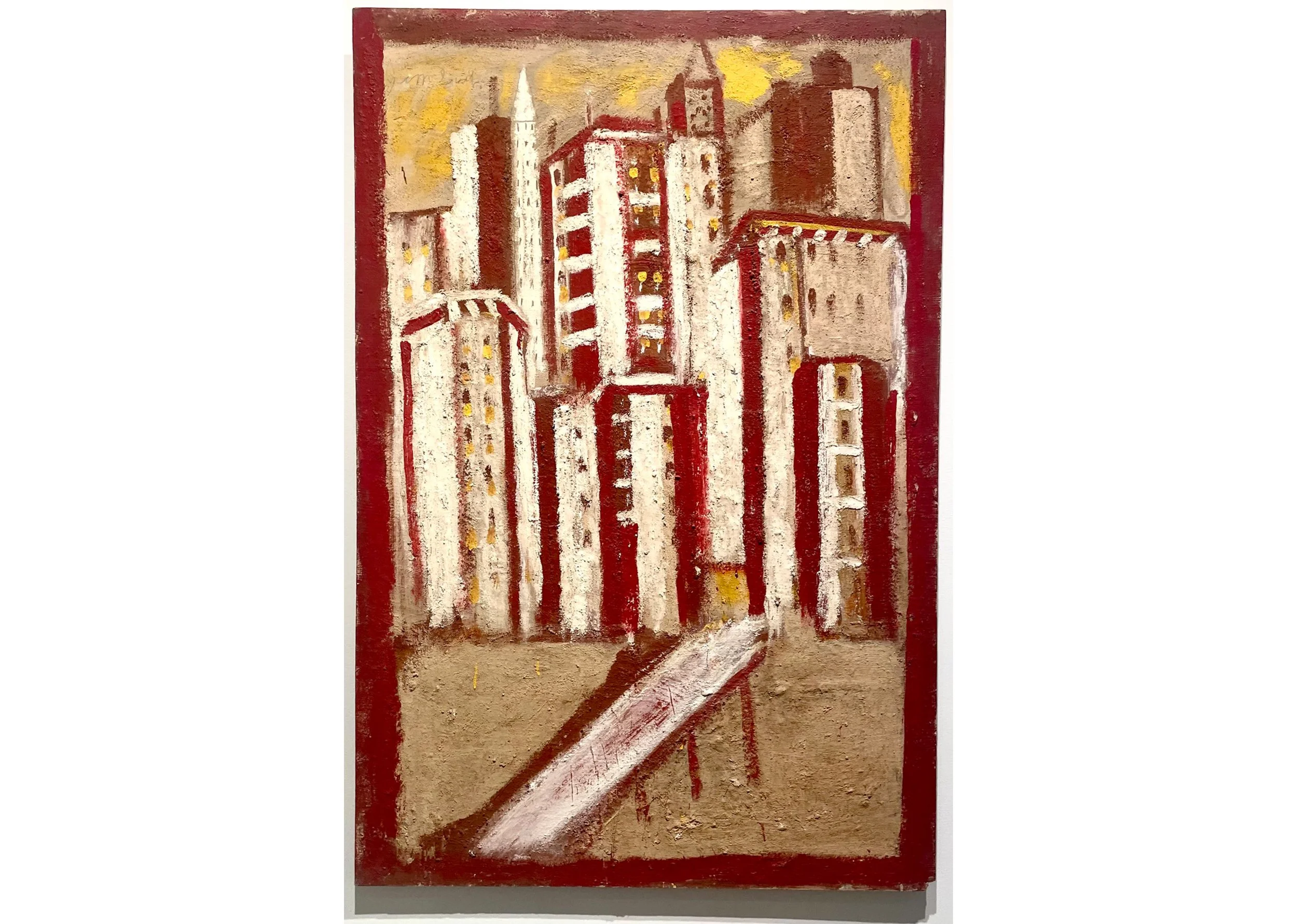
Jimmy Lee Sudduth, Atlanta, 1988; photo courtesy Leo Koenig, Inc.
In this elegant group show of figurative works, mainly paintings, there is an undercurrent of understated provocation as to how identity manifests itself in an artist’s work, and how the work mirrors the artists themselves, and ultimately, the viewer. Organized by artist, art writer and curator Ryan Steadman, the exhibition features an unusual and affective integration of outsider and insider artists, established art stars and new talent. The first work encountered near the entrance is an iconic work on paper, Mother and Child (1939) by the late Bill Traylor, whose highly stylized renderings are seminal works of self-taught art as a genre. This work makes a jarring but unforgettable contrast with Wine and Cheese (2017), a large study of two, gender-ambiguous figures and a bunch of grapes, by the irrepressible explorer of female sexuality, Lisa Yuskavage, hanging just across the gallery. In conceptually provocative arrangements, Steadman shows small, gemlike double-sided drawings by the insular and physically challenged outsider James Castle beside Alexander Harrison’s explorations of Black identity and Lisa Sanditz’s high-toned and humorous look at male and female interactions, in fauvist and quasi-surrealist collisions such as Mudslide (2025) and a larger canvas, The Green Woman (2026).
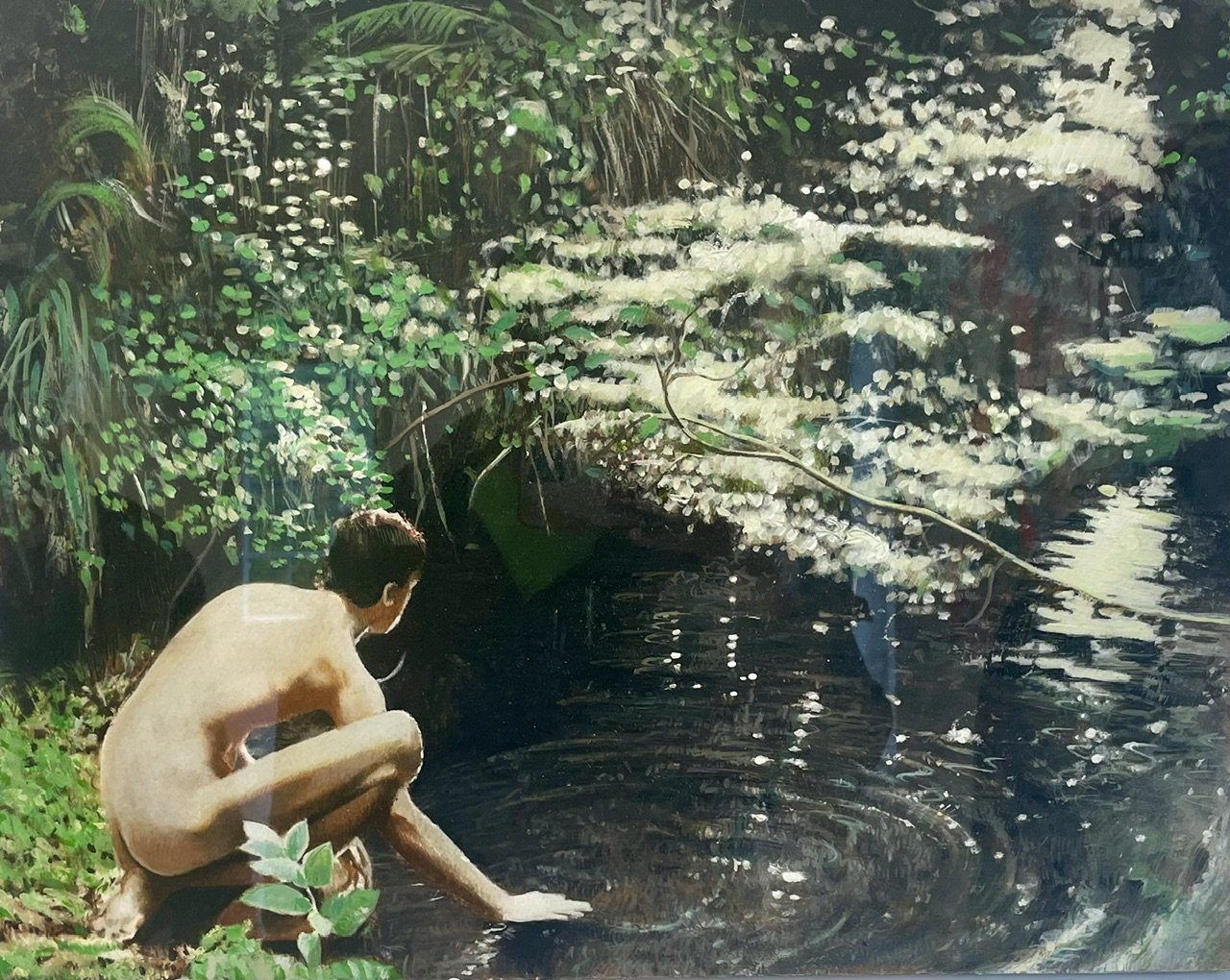
Leonard Baby And the water Loved me Back, 2026. Photo courtesy Leo Koenig.
Some of the works here are materially or tactilely seductive, such as Christoph Matthes’s large glittery composition Hit A Ceiling (2025), in which several luminous black-and-white striped fish swim in a shimmering pink sea. This work contrasts and complements the mud- and earthen-pigment compositions by the late Alabama self-taught maestro Jimmy Lee Sudduth, whose heavily encrusted cityscape Atlanta (1988) seems to have been built rather than painted, as if the artist were imagining himself as an architect in the image-making process. Richly textured domestic dramas painted by Natia Lemay are among the highlights of the exhibition in their combustible fusion of refined, decorative detail and gritty, raw emotion. The late Icelandic artist Louisa Matthíasdóttir is represented here by several lively, animal-populated landscapes that correspond directly to the surrounding, bucolic Catskills scenery visible just outside the gallery’s windows. Leonard Baby’s wonderful compositions focused on the male nude are dreamlike figure studies that are perhaps more focused on an exploration of sensuality rather than sexuality. Paint Your Life offers such a wide variety of observable (external) and cerebral (internal) forms of figurative expression that viewers are ultimately granted a contemplative and rewarding opportunity for self-reflection. —David Ebony
A LINE, A SHAPE, A TOOL at Geary Contemporary, Salisbury, CT, through July 15, ‘26.
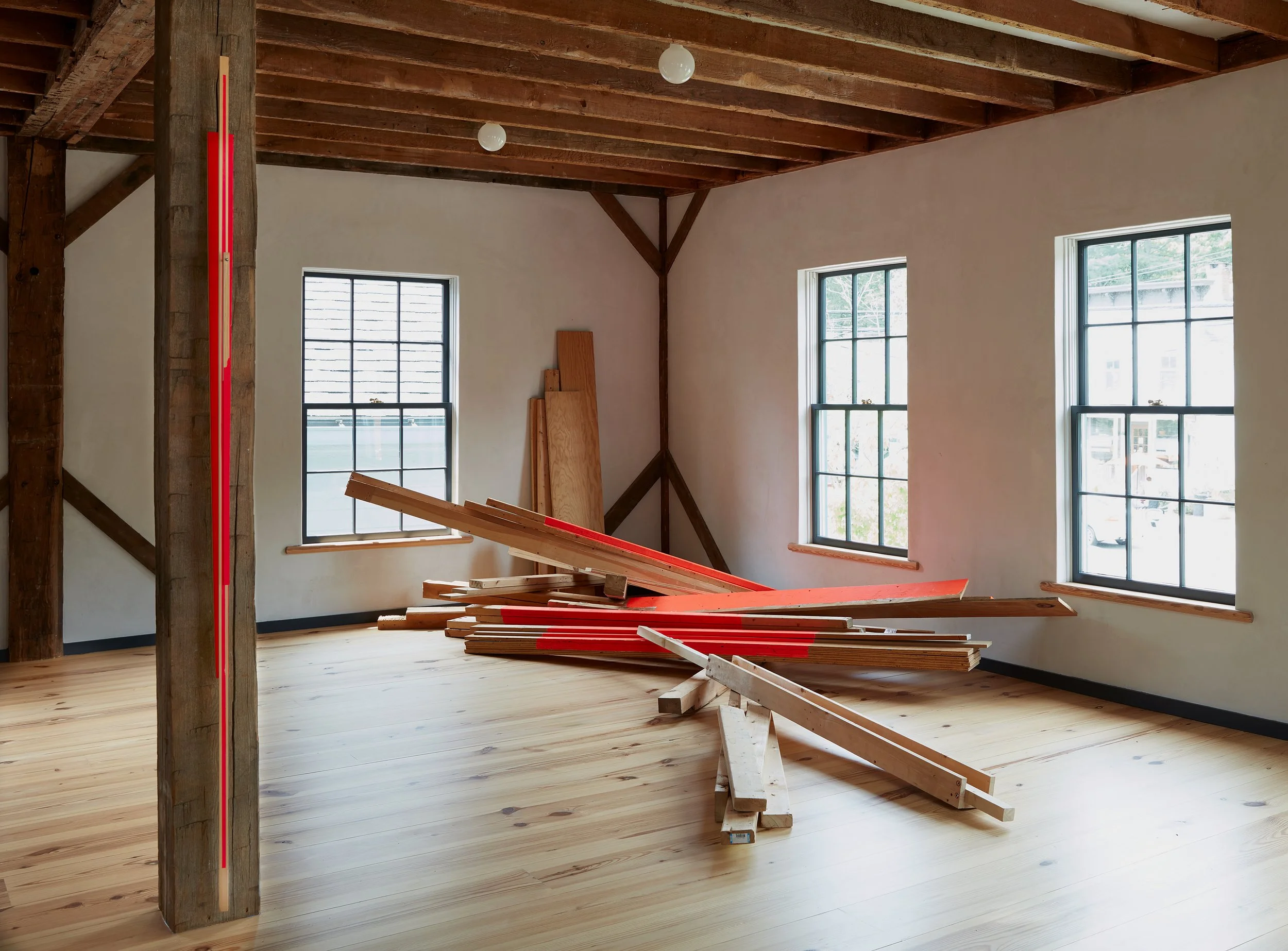
Installation view of A Line, A Shape, A Tool, showing Russell Maltz, ACCU-FLO, 2026 Lumber, plywood, paint, and fasteners Dimensions variable. Photo: Theo Coulombe; courtesy of Geary Contemporary.
Framed via a commissioned short story by Times critic and novelist Will Heinrich, the narrative functions almost as a fifth artist in this intoxicatingly chaotic exhibition of four sculptors. The show’s internal logic suggests that three-dimensional objects, by virtue of their material reality, inevitably carry traces of the histories embedded in their making. Unlike paint, a neutral medium awaiting transformation, sculpture starts as a thing in the world, no different from a chair. Materials arrive burdened with other functional uses and associations, whether in the oil-drum lids or debris assembled throughout A Line a Shape, A Tool.
Heinrich’s story unfolds through the voice of an anxious narrator haunted by recurring forms: a boat becomes a vulva; shapes seem forever changing. He wonders whether his compulsive rearranging of objects merely imitates what nature itself does without intentionality “Every morning I awoke with a new theory,” he writes. “First my body was made of atoms. Then it was an idea in the mind of God. Then instead of ‘God’ I said ‘deus sive natura.’”
The new Geary space quietly amplifies these concerns. Its exposed wooden columns and architectural irregularities domesticate some of the exhibition’s barely controlled chaos, especially in Russell Maltz’s massive ACCU-FLO (2026), a collapsed mound of lumber, plywood, and paint that resembles the aftermath of a construction project. Maltz introduces just enough formal intervention in a shifting rectangle of bright orange paint — to transform quotidian debris into sculpture. The point is reinforced by his accompanying photographs of construction sites presented as found sculpture.
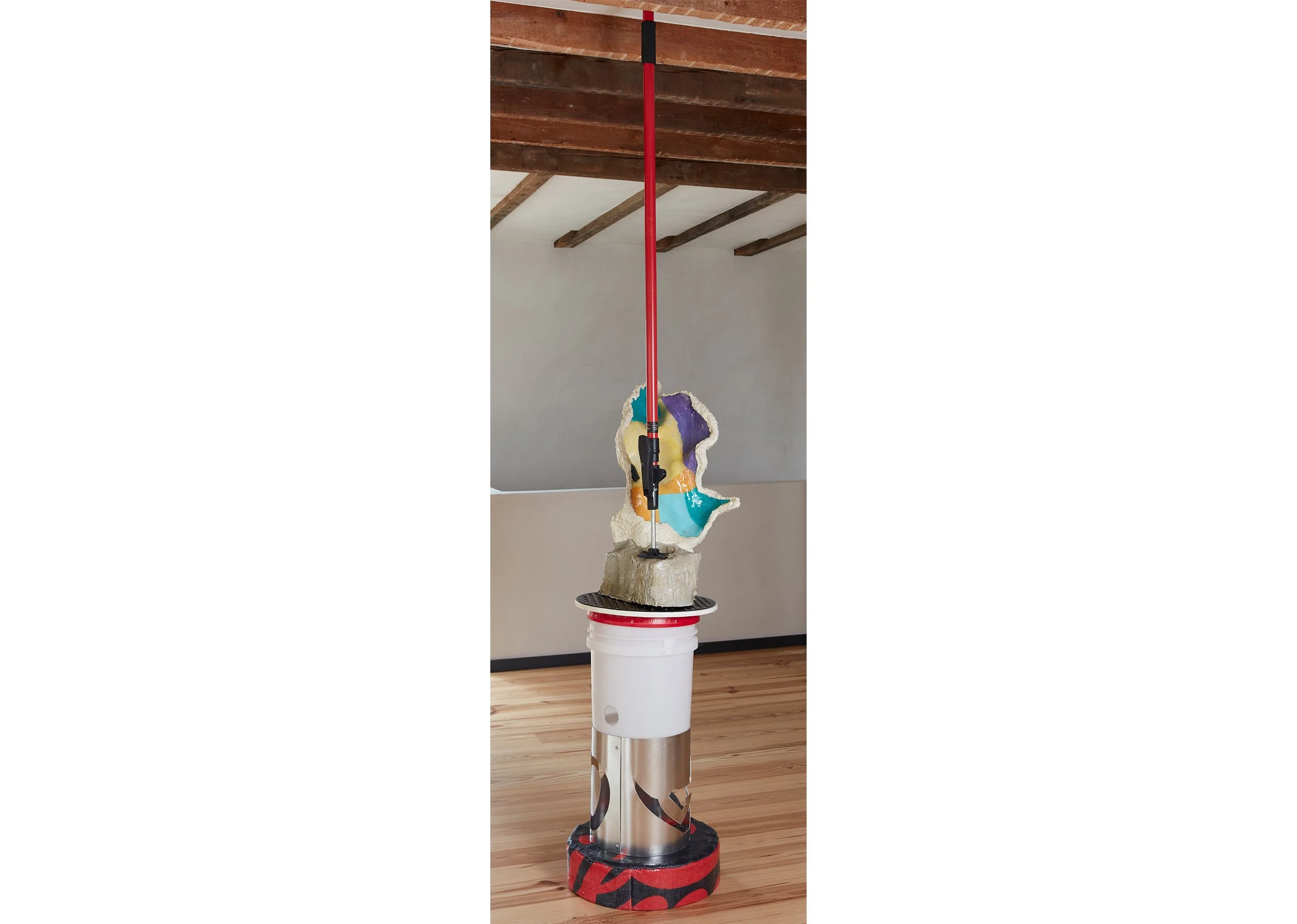
Installation view of A Line, A Shape, A Tool, showing Pooneh Maghazehe, Bird Trick, 2026 Hot glue, cement, kiddy pool, Flex Seal, ceiling jack, bucket, Plastidip, steel, housepaint, 18 x 18 x 96.” Photo: Theo Coulombe; courtesy of Geary Contemporary.
William Corwin contributes cast-iron tables, boats, and ladders whose dense physicality and almost oppressive gravity most directly embody Heinrich’s shape-haunted fictional universe.
If Maltz and Corwin operate in a materially register, Sun You offers something closer to a Mozartian counterpoint: delicate balances of floating forms that seem capable of lifting off their pedestals entirely, fragments of color suspended on thin wires.
Pooneh Maghazehe proves the exhibition’s most restlessly inventive presence. Her Bird Trick, incorporating found objects like ceiling jack and kiddie pool, becomes the show’s most captivating moment — an unlikely convergence of functional objects transformed into something strange, theatrical, and psychologically charged just on the edge the uncanny. The four artists are deployed in each of the galleries three spaces in such a way as to draw us into an anxious viewing experience aligned with the fictive wandering from one puzzling object to the next. — Bill Arning