
Words Glenn Adamson Photography Chris Mottalini
Published in No 21
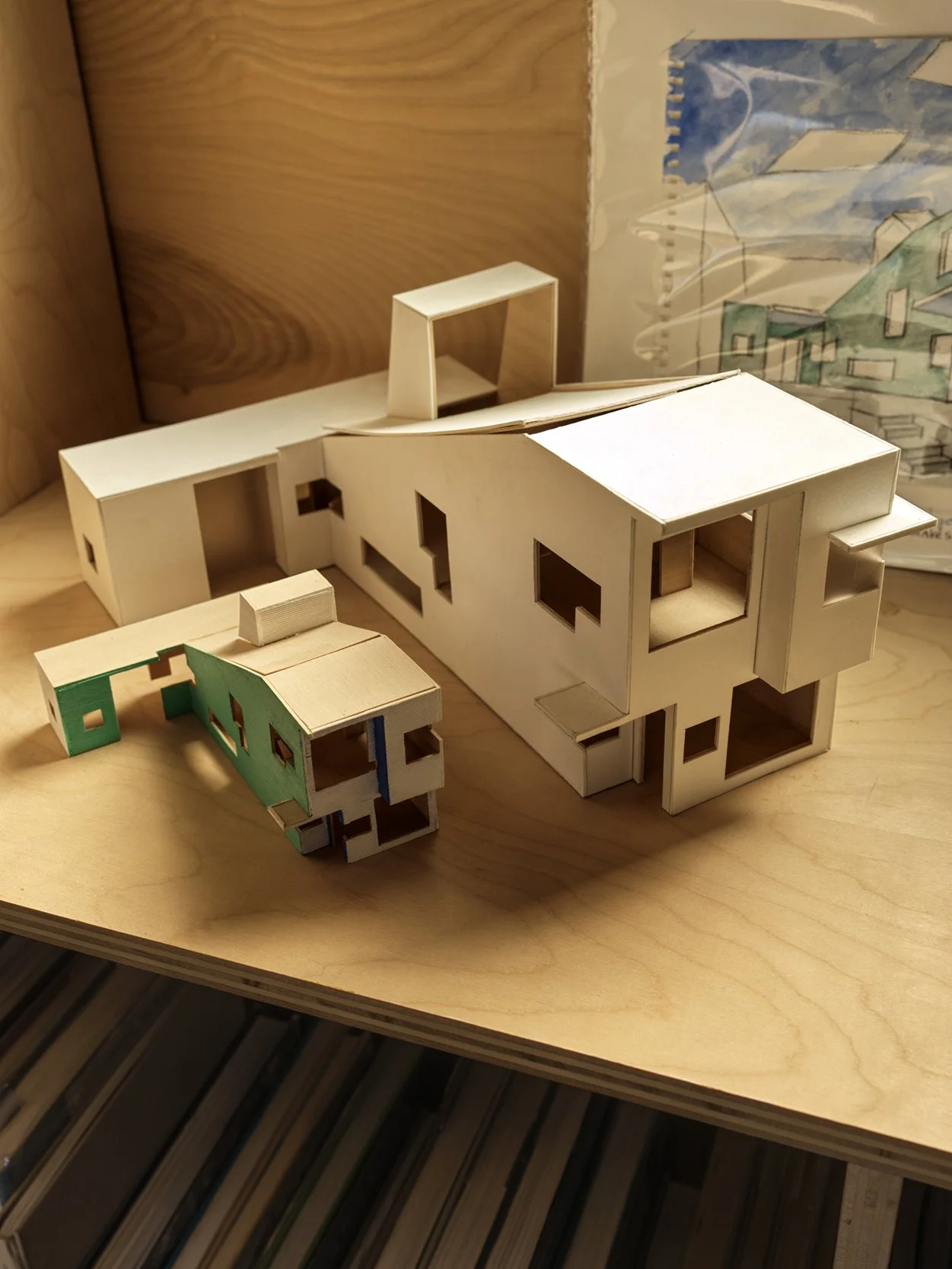
Steven Holl’s working model of the house.
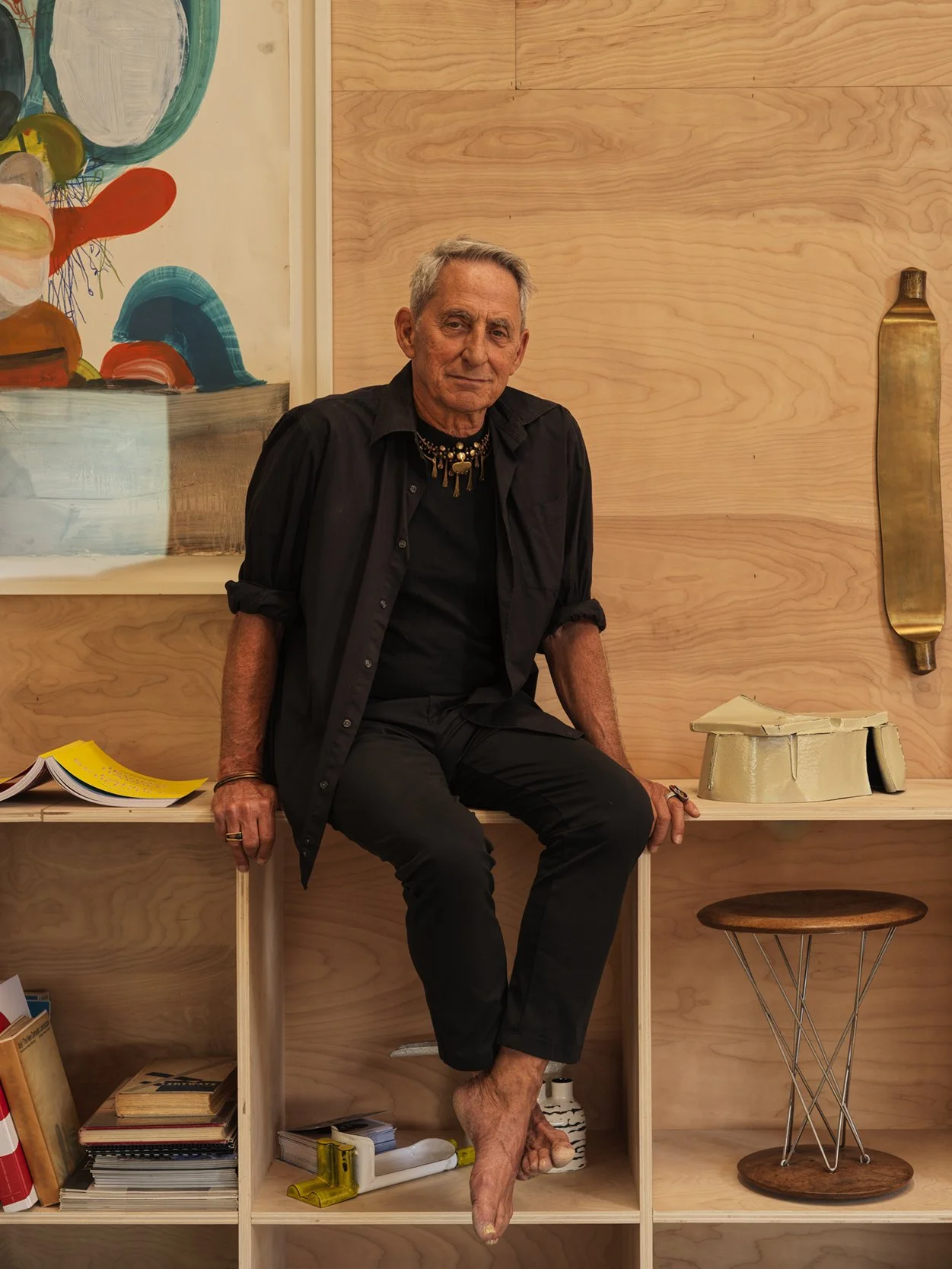
McDonald in Jil Sander shirt, Carhartt WIP pants, Uniqlo t-shirt, and a bronze necklace by Jack Boyd c.1970.
“The structure long ago ceased to exist. I am not aware of it.” So said Ray Eames of the house she and her husband Charles completed in 1949 and lived in for the rest of their days. Built as one of a series of Case Study Houses, sponsored by Arts & Architecture magazine as “experiments in living,” it was avant-garde for its day, a pair of glass boxes (one to work in, one to sleep in) with primary-colored panels inset into its steel grid. Step inside, though — the interiors are beautifully preserved, filled with the Eameses’ own designs and their lovingly collected objects — and you can immediately tell that being here, for them, came as second nature.
Mark McDonald knew Ray Eames well, though they got off to a bumpy start. As a co-founder of the legendary New York design gallery Fifty/50, which opened in 1983, McDonald was one of the pioneers of midcentury modern design, defining connoisseurship in the field and establishing a growing market. Eames pieces, including storage units originally developed for the Case Study House, were among the hottest sellers at Fifty/50. One exhibition, inspired by the disco hit “It’s Raining Men,” featured original Eames plywood chairs hanging from the ceiling. When Ray heard about the gallery, though, she was appalled. “Their idea had been to make low-cost furniture that people could afford,” McDonald says, “and we were selling pieces for $500 and up.” She gradually came around, recognizing that the increasing value of their earlier work was itself a form of sincere appreciation, and Mark had the privilege of becoming her close friend for a few years. When Ray died in 1988 — ten years to the day after Charles — it was the team at Fifty/50 who were invited to appraise the Eames estate.
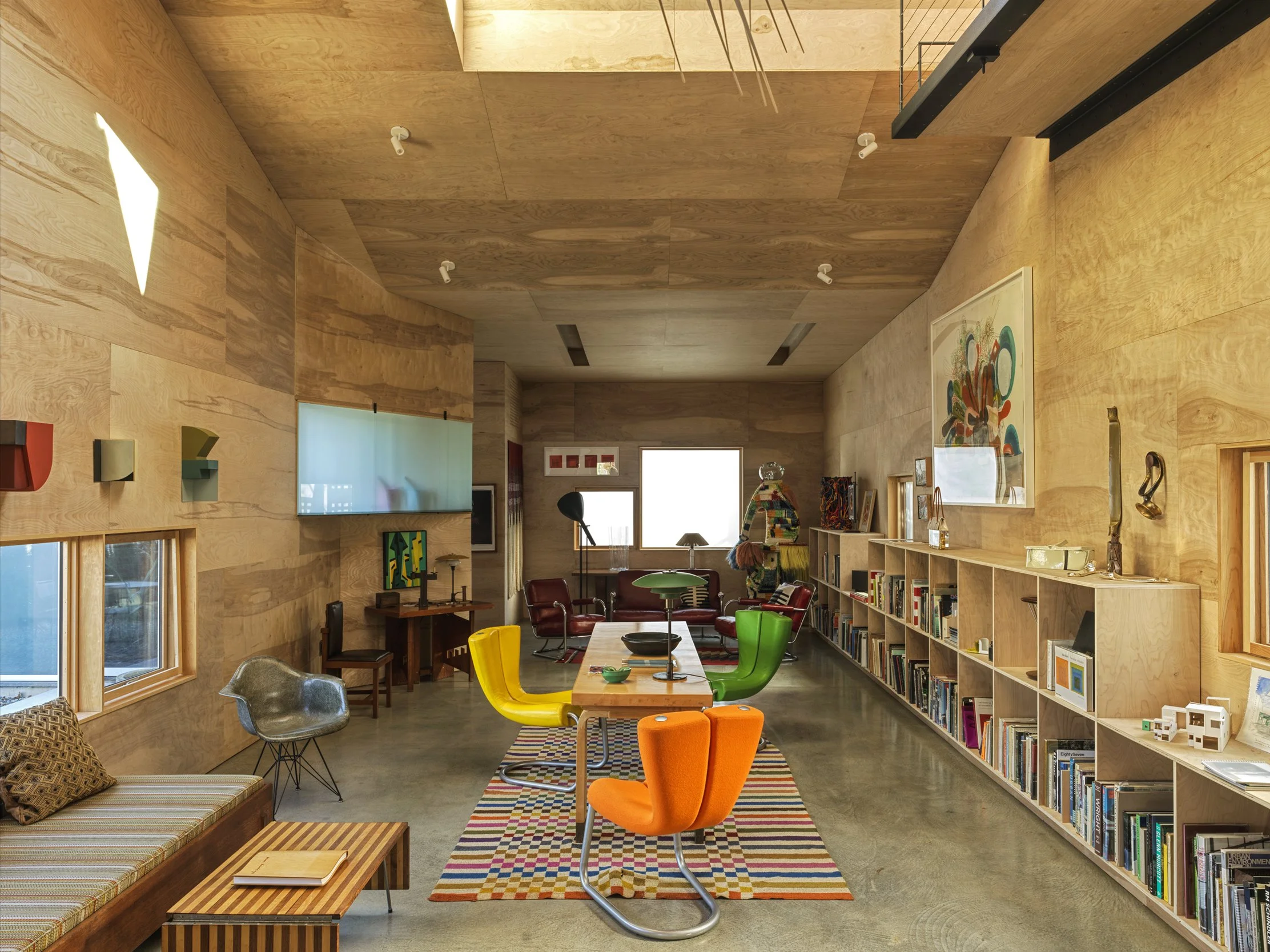
The studio-library, with a 1950s Alvar Aalto table and three Komed chairs by Marc Newson, 1998. On the wall, Ripples, 1995, by Santi Moix.
Now, McDonald has paid them the ultimate tribute by building his own case study house, in Hudson, New York. Designed by the husband-and-wife team of Steven Holl and Dimitra Tsachrelia, it goes by the name of the L house, because that simple shape is repeated throughout its 1700-square-foot plan, elevations, and detailing. This indicates some shared design DNA with the Eames’ grid-based masterwork, with the many L’s introducing dynamic asymmetry. Earlier California modernists like Irving Gill, Richard Neutra and Rudolph Schindler — all known for their combination of clean, boxy lines and immaculately handcrafted detailing — were also important references. Despite the erudition that went to its making, however, the L House is very much an “experiment in living,” one that responds to the needs of today.
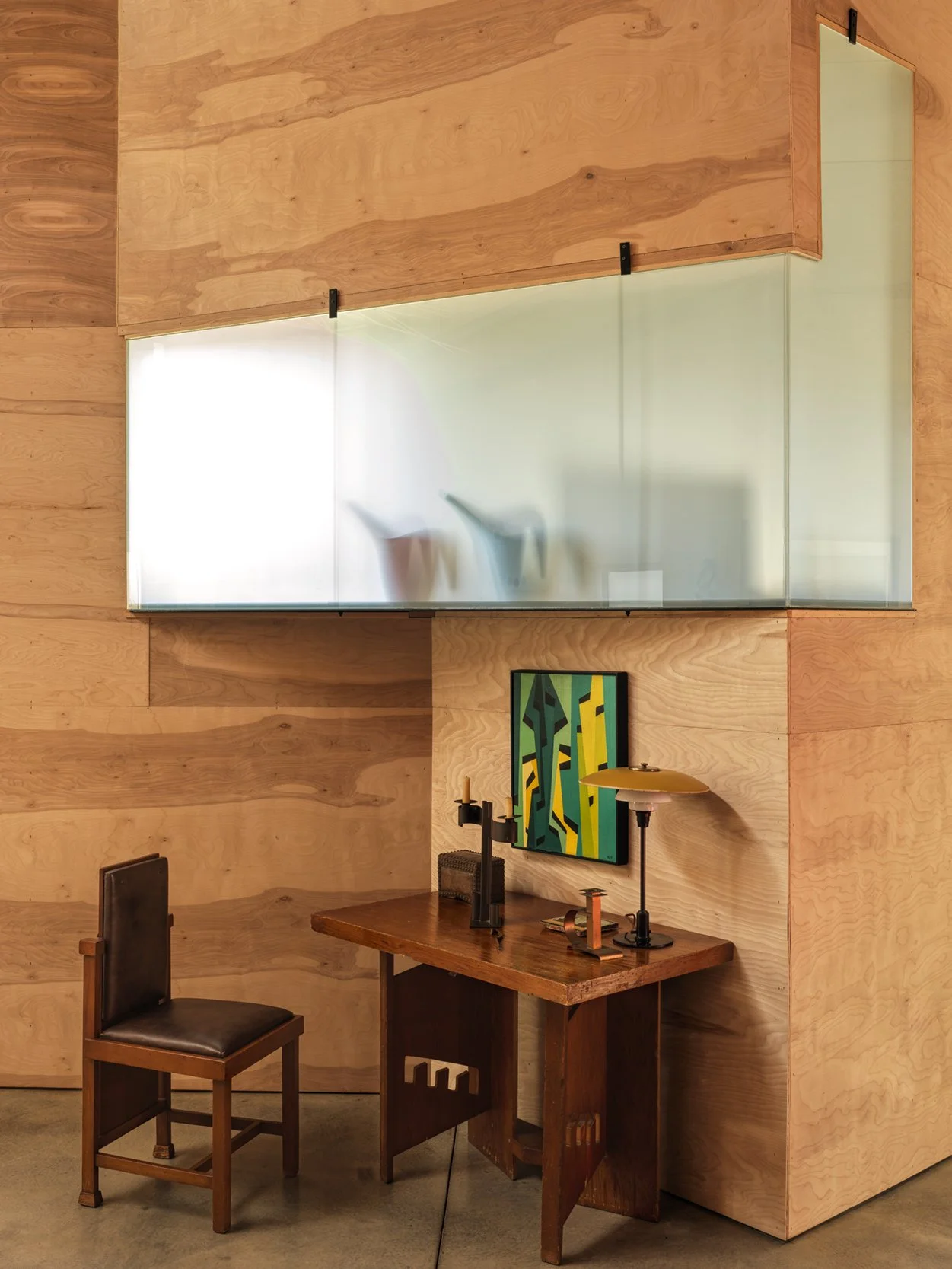
A Frank Lloyd Wright slatback chair, 1908, paired with a Wright table, 1939.
First and foremost, it is the first building in Hudson with a geothermal heating and cooling system. If you’re just hearing about this now for the first time, just wait a few years: it is one of the most ecologically efficient ways of controlling building temperature, and soon, hopefully, it will be everywhere. It is simple in principle: dig a very deep well until you get to groundwater that’s about 50 degrees Fahrenheit. Pump that water up, put it under a little pressure to raise the temperature, and you have heat for the winter. Come summer, the same system provides efficient cooling. Holl has helped to pioneer in this technology, using it for his office’s own Archive and Research Building. By his standards the L House is modestly scaled: in 2009, his office completed a complex with the largest geothermal array in China, comprising 660 separate wells, each 100 meters deep. Every little bit helps, though, and he hopes that the project in Hudson may help to spread the good word in upstate New York, where it is especially well suited to the climate.
Meanwhile, McDonald is continuing his work as a messenger of modernism. Fifty/50 closed in 1993, after his business partners Ralph Cutler and Mark Isaacson were both lost to AIDS, but he has remained active as a design dealer ever since, relocating his business to Hudson in 2003. The lot for the L-House is right behind his former gallery, a three-storey department store built in 1910 he owned for two decades — plenty of space, but expensive to heat and maintain. He dreamed of down-sizing into a tighter, more efficient space. Though the new house does have a bedroom, he and his husband Dwayne Resnick still maintain another residence in nearby Hillsdale, so it serves mainly as a showcase of progressive architecture, and for gems from McDonald’s extensive collection.
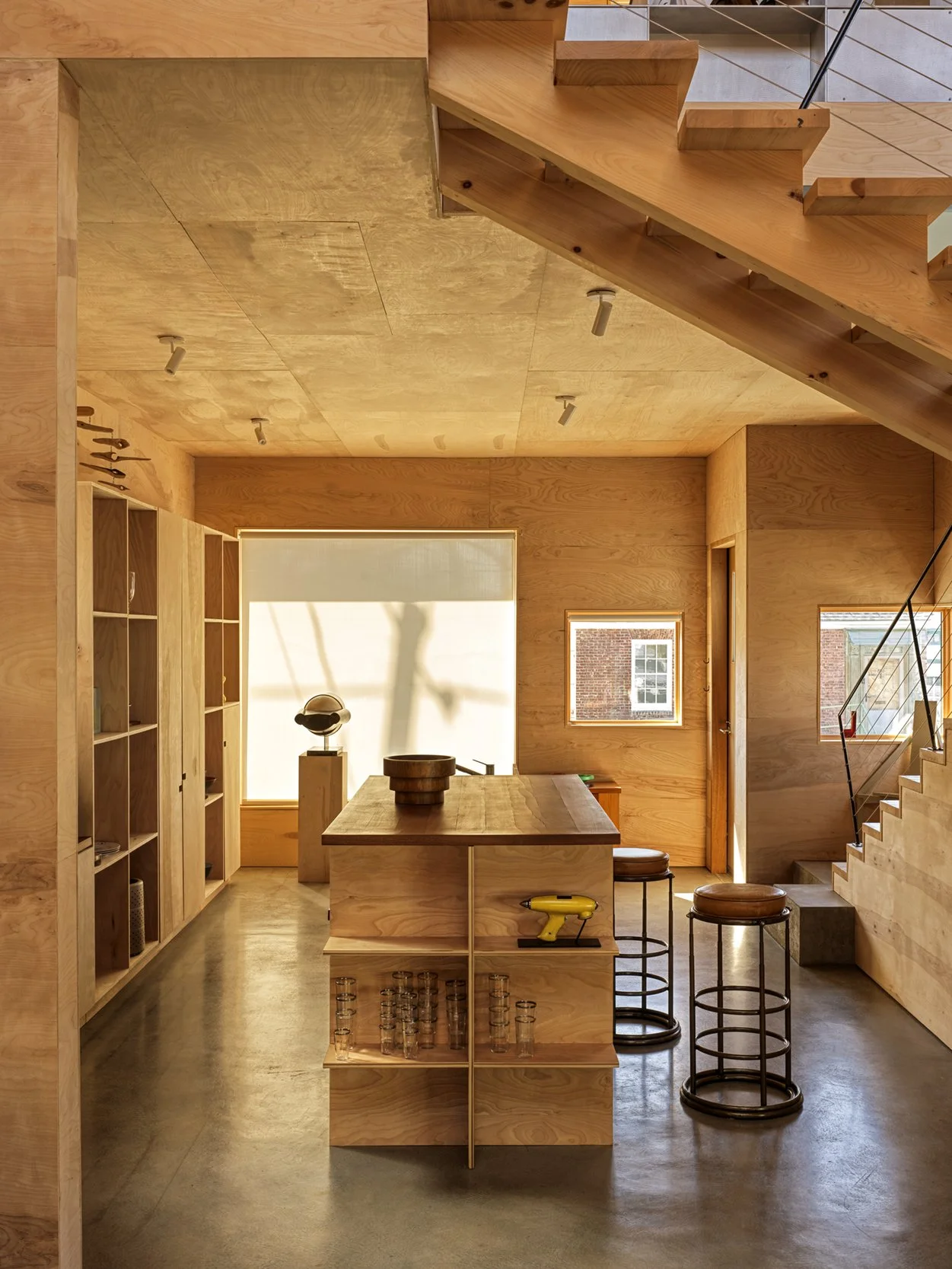
The adaptable entry / kitchen incorporates appliances that can be concealed under a removable countertop when entertaining.
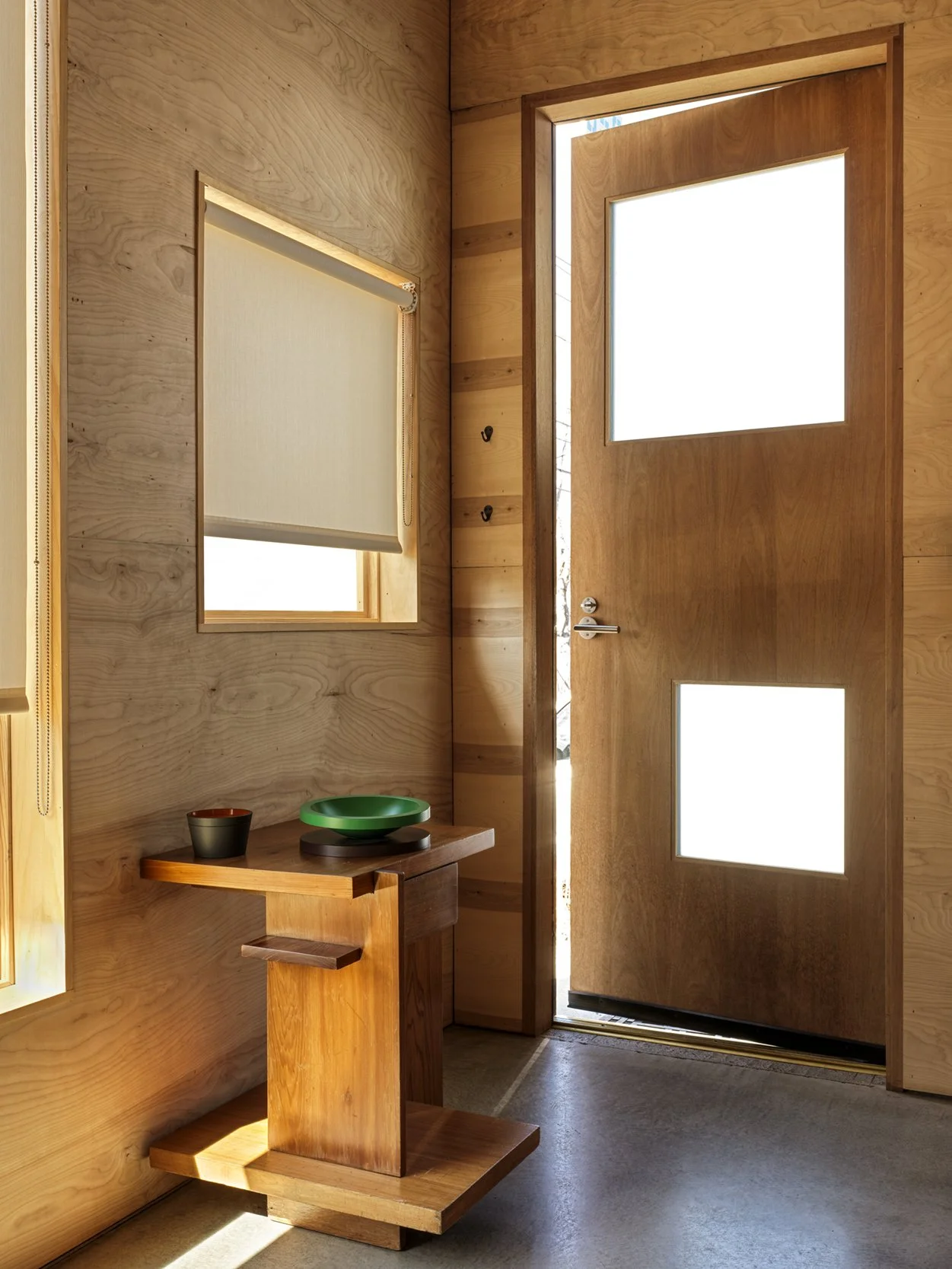
Visitors are greeted by an exterior light fixture from Frank Lloyd Wright’s 1914 Francis W. Little House in Wayzata, Minnesota; it is clasped like a giant brooch on to a concrete wall designed for the purpose, an unusual example of lighting determining architecture, rather than the other way round. Behind the wall is a courtyard with a fountain and reflecting pool, nestled into the large “L” of the building plan. Step inside the house, and one encounters a kitchen with an ingenious feature: a removable tabletop that fits over the whole central island, to provide additional work surface and display space for objects. Beyond, the space opens out dramatically into an atrium-like living room with north and south facing skylights, filled with treasures — more furniture by Wright, a sculptural light by young phenom Misha Kahn, period tubular steel seating (possibly by Kem Weber or Gilbert Rohde) in conversation across the decades with a set of chairs by Marc Newson. Pride of place goes to a vintage Eames chair in perfect condition, its early date apparent from its original Zenith label, distinctive rubber feet (described by the manufacturer, intriguingly, as “domes of silence”), prominent filaments in its fiberglass, and embedded rope running around its edge. The rope was for ease of handling when the fiberglass shell popped out of the mold, as the original process left dangerously sharp edges.
Keep exploring the house and it keeps delivering. In the back office are two biomorphic display cases designed by Harry Allen, filled with modernist jewelry, including pieces by Art Smith, the pioneering jeweler with a name too good to be true (he was also one of the few prominent African-American figures in the craft movement), whose work McDonald helped elevate to greater visibility in the 1990s; more recently he helped build a representative collection of Smith’s jewelry at the Smithsonian’s National Museum for African American History and Culture. Upstairs, one finds a Kem Weber Airline chair, originally made for a Disney film screening room in 1940, a cluster of abstract ceramics by Leza McVey, a stalwart of the Cleveland art scene, whom McDonald also befriended in her later life and again helped to establish as a significant figure in design history. He has also made a place for contemporary makers from the Hudson Valley, including the wonderful Myra Mimlitsch-Gray, arguably the USA’s most skilled and inventive master of hollowware and a longtime faculty member at SUNY New Paltz, and Christopher Kurtz, whose elegant wooden Meridian sculpture hangs from the ceiling, looking for all the world like a three-dimensional star chart.
Most of the L House’s exterior is sheathed in green corrugated steel, fabricated using a customized extrusion die so that it has unusually tight channels, like narrow-wale corduroy. The interior, meanwhile, is clad in 260 sheets of natural birch plywood. This is hardly a luxurious material, but its cumulative effect is extremely sophisticated, partly because of occasional offsetting accents in mahogany, but mostly because of the extraordinary play of natural light against the pale timber walls. The asymmetric fenestration and skylights yield patterns of constantly shifting parallelograms. This is what it might feel like to live inside a Bridget Riley (one of her prints is on display next to the staircase). Continue reading in issue 21.
Glenn Adamson is a curator, writer and historian based in upstate New York and London. @glenn_adamson glennadamson.com
Chris Mottalini is a regular contributor to UD. @chrismottalini Chrismottalini.com